English
 Español
 tiếng việt
 русский
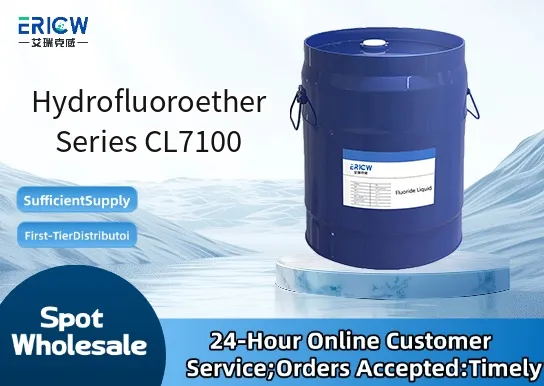
Zero ozone depletion potential (ODP = 0) and low global warming potential (GWP < 15).
Nonflammable with high dielectric strength (>40 kV/2.5 mm), suitable for live-electronics cleaning.
Low surface tension (<16 mN/m) and excellent residue-free drying performance.
Chemically inert toward most metals, plastics, and elastomers commonly used in precision assemblies.
Compatible with existing vapor degreasing and precision cleaning equipment without retrofitting.
Cleaning of high-reliability electronic components including PCBs, connectors, and MEMS devices.
Rinsing and drying step in semiconductor front-end and back-end packaging processes.
Defluxing of no-clean and rosin-based solder pastes in aerospace and defense electronics.
Final rinse for medical device subassemblies requiring ISO 13485-compliant residue control.
Surface preparation prior to conformal coating or bonding in optical and photonics manufacturing.
| Chemical Type | Linear hydrofluoroether (HFE), C5–C6 branched structure |
| Product Form | Clear, colorless liquid |
| Appearance | Transparent, odorless liquid |
| Melting Point | Below −90 °C |
| Boiling Point (1 atm) | ~61 °C |
| Density (20 °C) | 1.32–1.34 g/cm³ |
| Primary Applications | Vapor degreasing, precision rinsing, and final drying |
| Regulatory Compliance | REACH registered; compliant with EU RoHS 2015/863; non-Prop 65 listed |
| Common Compatible Systems | Suitability |
| Standard stainless-steel vapor degreasers (e.g., Precision Cleaning Systems Model VD-3000) | Highly Recommended – No material compatibility issues; optimized recovery efficiency |
| Ultrasonic cleaning systems with Teflon®-lined tanks and 40–60 kHz transducers | Recommended – Requires temperature control ≤50 °C to maintain stability |
| Batch spray-in-air cleaners with polypropylene fluid paths | Suitable – Verify elastomer seals (use Viton® or Kalrez®; avoid Buna-N) |
| Automated inline cleaning lines with stainless-steel piping and diaphragm pumps | Highly Recommended – Fully compatible with 316 SS and PFA tubing |
Q1: What is the CAS Registry Number for CL7100?
A: The CAS number for Hydrofluoroether Series CL7100 is 1321303-09-2.
Q2: What is the recommended process concentration when used as a rinse agent?
A: CL7100 is used neat (100% concentration); dilution is not required or recommended for optimal cleaning and drying performance.
Q3: How does CL7100 compare to HFC-43-10mee or traditional chlorinated solvents?
A: Unlike HFC-43-10mee, CL7100 offers lower GWP, higher thermal stability, and superior material compatibility—especially with polycarbonate and acrylic optics. It avoids the toxicity and regulatory restrictions associated with chlorinated solvents.
Q4: Is CL7100 approved for use in FDA-regulated medical device manufacturing?
A: While CL7100 itself is not an FDA-listed substance, it is widely accepted under FDA 21 CFR Part 173.370 for indirect food contact and meets residual limits per USP <846> for pharmaceutical-grade cleaning validation.
Q5: Does CL7100 exhibit migration or leaching into sensitive polymer substrates during extended dwell times?
A: No significant migration or plasticization has been observed in validated studies with ABS, PC, PEEK, and silicone elastomers at ambient temperature and dwell times up to 10 minutes.
Contact With Us:
E-mail: wangxingqiang@ericwchem.com
Have a Questions? Call Us:
Add:
Building A1, Jiete Industrial Park, Huangpu District, Guangzhou City, Guangdong Province, China