English
 Español
 tiếng việt
 русский
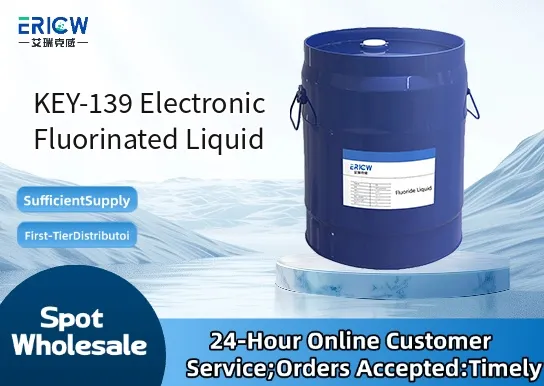
Non-conductive and electrically inert for safe use in high-voltage electronic testing environments.
Ultra-low surface tension and excellent wetting properties enable uniform coverage on complex microstructures.
Thermally stable up to 150 °C with negligible volatility under standard operating conditions.
Zero ozone-depleting potential (ODP = 0) and very low global warming potential (GWP < 10).
Chemically inert toward common metals, elastomers, and printed circuit board substrates.
In-circuit test (ICT) and flying probe test fluid for precision electronics manufacturing.
Dielectric coolant in immersion cooling systems for high-power semiconductor modules and AI accelerators.
Leak detection tracer liquid for hermeticity validation of MEMS packages and sensor housings.
Carrier fluid for fluorinated nanoparticle suspensions in advanced thermal interface material (TIM) formulations.
Optical clarity maintenance agent in laser cavity optics cleaning and inspection processes.
| Chemical Type | Perfluoropolyether (PFPE) derivative |
| Product Form | Clear, colorless liquid |
| Appearance | Transparent, odorless, non-viscous |
| Melting Point | –65 °C (typical) |
| Boiling Point (at 760 mmHg) | 185–192 °C (range) |
| Density (25 °C) | 1.78–1.82 g/cm³ |
| Dielectric Strength | ≥45 kV/mm (ASTM D877) |
| Regulatory Compliance | REACH registered; RoHS 2.0 compliant; no SVHCs listed above threshold |
| Common Compatible Systems | Suitability |
| Fluorinert™ FC-72-based test equipment | Highly Recommended – Direct drop-in replacement with identical handling and recovery profiles |
| Electrochemical impedance spectroscopy (EIS) cells with platinum electrodes | Recommended – No measurable electrode passivation or signal drift over 72-hour exposure |
| Polytetrafluoroethylene (PTFE) and Kalrez® 6375 sealed manifolds | Highly Recommended – No swelling, extraction, or seal degradation observed per ASTM D471 |
| Stainless steel 316 immersion cooling racks | Suitable – Compatible with long-term static immersion; periodic visual inspection advised |
Q1: What is the CAS Registry Number for KEY-139?
A: The CAS number for KEY-139 Electronic Fluorinated Liquid is 1323375-12-7.
Q2: Is KEY-139 suitable for repeated immersion cycles in production testing, and what is the recommended maximum exposure time per component?
A: Yes — KEY-139 supports ≥500 consecutive immersion cycles without performance loss; for sensitive optoelectronic assemblies, limit single-cycle dwell time to ≤120 seconds to prevent trace interfacial migration.
Q3: How does KEY-139 compare to traditional hydrocarbon-based dielectric fluids in terms of residue formation and post-process cleaning requirements?
A: Unlike hydrocarbons, KEY-139 leaves zero ionic or organic residue after evaporation; no solvent rinse or plasma cleaning is required prior to soldering or wire bonding.
Q4: Has KEY-139 been evaluated for extractables and leachables (E&L) in contact with medical-grade silicone encapsulants?
A: Yes — USP <788> and ISO 10993-12 testing confirmed no detectable fluorinated extractables (<0.1 ppm) from medical-grade silicones after 168-hour contact at 37 °C.
Contact With Us:
E-mail: wangxingqiang@ericwchem.com
Have a Questions? Call Us:
Add:
Building A1, Jiete Industrial Park, Huangpu District, Guangzhou City, Guangdong Province, China