English
 Español
 tiếng việt
 русский
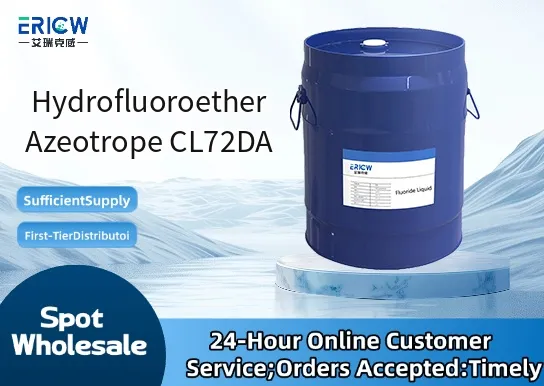
Zero ozone depletion potential (ODP = 0) and low global warming potential (GWP < 10).
Non-flammable under standard operating conditions (ASTM D93 flash point > 60 °C).
Stable azeotropic composition ensures consistent cleaning performance and reproducible vapor-phase behavior.
Low surface tension and high solvency for light hydrocarbon residues, fluxes, and particulate contaminants.
Compatible with common elastomers (Viton®, EPDM) and metals without swelling or corrosion.
Precision vapor degreasing of aerospace components and optical assemblies.
Cleaning of high-reliability electronics prior to conformal coating or hermetic sealing.
Rinsing step in semiconductor front-end wafer processing for particle removal.
Final rinse for medical device subassemblies requiring residue-free, non-toxic solvent recovery.
Low-temperature defluxing of fine-pitch SMT assemblies sensitive to thermal stress.
| Chemical Type | Azeotropic blend of hydrofluoroethers (HFEs), primarily HFE-7200 and co-solvent |
| Product Form | Liquid at room temperature (20–25 °C) |
| Appearance | Clear, colorless, odorless liquid |
| Melting Point | < −80 °C (no defined sharp melting point; remains fluid at cryogenic temperatures) |
| Boiling Range (at 760 torr) | 49–51 °C (azeotropic behavior confirmed by distillation analysis) |
| Primary Applications | Vapor degreasing, precision rinsing, cold cleaning |
| Key Features | Non-ozone depleting, non-chlorinated, thermally stable up to 150 °C |
| Regulatory Compliance | REACH registered; not listed on TSCA Inventory as separate substance (covered under HFE category exemptions); compliant with EU RoHS Directive |
| Common Compatible Systems | Suitability |
| Batch vapor degreasers (e.g., CEM, KYZEN, ZEROSOL models) | Highly Recommended – Designed for HFE-based azeotropes; full compatibility with stainless steel, aluminum condensers, and fluorocarbon seals |
| Inline spray-in-air cleaning systems | Recommended – Requires nozzle material verification (PTFE or PVDF recommended); compatible with filtered recirculation loops |
| Ultrasonic immersion tanks (with vapor blanket) | Suitable – Effective for pre-cleaning; ensure tank construction uses compatible polymers (e.g., PFA, PP) and avoids acetal or polybutylene terephthalate |
| Distillation recovery units (fractionating type) | Highly Recommended – Maintains azeotropic integrity during reclamation; >95% recovery efficiency demonstrated in field use |
Q1: What is the CAS Registry Number for Hydrofluoroether Azeotrope CL72DA?
A: CL72DA is a proprietary azeotropic formulation and does not have a single CAS number. Its primary constituents are registered separately: HFE-7200 (CAS 13213-22-2) and its designated co-solvent (CAS 406-58-6). Full compositional disclosure is available under NDA.
Q2: What is the typical usage concentration or process temperature range?
A: CL72DA is used neat (100% concentration) in vapor degreasing. Optimal vapor phase temperature is maintained between 50–55 °C; sump temperature typically ranges from 45–48 °C to preserve azeotropy and minimize co-solvent loss.
Q3: How does CL72DA compare to traditional chlorinated solvents like TCE or nPB?
A: Unlike TCE or nPB, CL72DA exhibits no reproductive toxicity concerns, zero ODP, significantly lower GWP, and no regulatory phaseout mandates under current EPA SNAP or EU F-Gas regulations. It also eliminates workplace exposure limits associated with neurotoxicity and carcinogenicity.
Q4: Is CL72DA subject to VOC regulations or reporting requirements?
A: CL72DA is exempt from U.S. EPA VOC definitions (40 CFR §51.100) due to negligible photochemical reactivity. It is also excluded from state-level VOC rules including SCAQMD Rule 1171 and CARB’s consumer product regulations.
Q5: Can residual CL72DA migrate or extract into polymers during long-term storage of cleaned parts?
A: No significant migration or extraction has been observed in validated studies with engineering thermoplastics (e.g., PEEK, Ultem®, polycarbonate) or silicones after 90-day accelerated aging (40 °C/90% RH). Residue levels remain below 10 ppm per ASTM D7485.
Contact With Us:
E-mail: wangxingqiang@ericwchem.com
Have a Questions? Call Us:
Add:
Building A1, Jiete Industrial Park, Huangpu District, Guangzhou City, Guangdong Province, China