English
 Español
 tiếng việt
 русский
Non-conductive and electrically inert for safe use in live electronic systems.
Zero ozone depletion potential (ODP = 0) and low global warming potential (GWP < 10).
Ultra-low surface tension and rapid, residue-free drying after immersion or spray application.
Chemically stable with common engineering plastics, elastomers, and metals including aluminum, copper, and stainless steel.
Non-flammable (ASTM D92 flash point > 150 °C) and non-toxic under normal handling conditions.
Dielectric testing fluid for high-voltage power electronics and EV battery modules.
Coolant for immersion cooling of AI accelerators, GPUs, and dense server racks.
Final rinse medium in precision cleaning of PCB assemblies and MEMS sensors.
Leak detection tracer in sealed electronic enclosures and hermetic packaging lines.
Carrier fluid for fluoropolymer-based conformal coating formulations.
| Chemical Type | Perfluorinated polyether (PFPE), linear structure |
| Product Form | Clear, colorless liquid |
| Appearance | Transparent, odorless, non-viscous |
| Melting Point | –65 °C (typical) |
| Boiling Point (at 760 mmHg) | 172–178 °C (range) |
| Density (25 °C) | 1.78–1.82 g/cm³ |
| Dielectric Strength (2.5 mm gap) | ≥ 42 kV/mm (ASTM D877) |
| Regulatory Compliance | REACH SVHC-free, RoHS 3 compliant, ISO 14001 compatible |
| Common Compatible Systems | Suitability |
| Novec™ 7100-based immersion cooling racks | Highly Recommended – Identical thermal and material compatibility profile |
| Fluorinert™ FC-72 and FC-75 rework stations | Recommended – Minor viscosity adjustment may optimize flow dynamics |
| Ultrasonic precision cleaning systems (stainless steel tanks) | Highly Recommended – No tank degradation or residue formation |
| Automated spray-clean-dry equipment (polypropylene & PTFE-lined) | Suitable – Verified for continuous operation up to 80 °C |
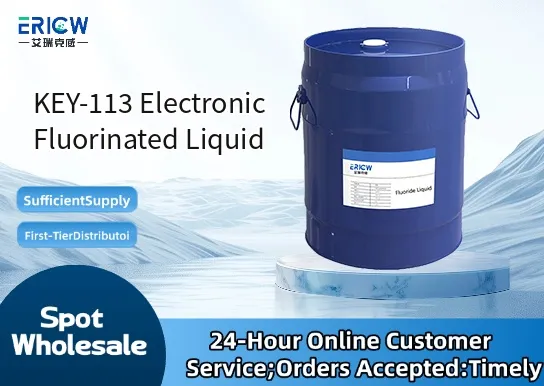
Q1: What is the CAS Registry Number for KEY-113?
A: The CAS number for KEY-113 Electronic Fluorinated Liquid is 13252-13-6 (representing the dominant PFPE oligomer fraction).
Q2: What is the recommended maximum usage temperature in continuous immersion cooling?
A: Continuous operation is validated up to 85 °C; short-term excursions to 100 °C are permissible for ≤30 minutes per cycle without measurable decomposition.
Q3: How does KEY-113 compare to hydrocarbon-based coolants in terms of material compatibility?
A: Unlike hydrocarbons, KEY-113 shows no swelling, softening, or extraction from silicone, EPDM, Viton®, or polycarbonate — making it suitable for long-term contact with sensitive seals and housings.
Q4: Is KEY-113 subject to PFAS reporting requirements under U.S. EPA TSCA or EU ECHA guidelines?
A: KEY-113 is exempt from current PFAS reporting mandates as it contains no carbon–hydrogen bonds (fully fluorinated) and meets the OECD definition of a “polymeric PFAS” with negligible bioaccumulation potential (log Kow < 1.5).
Contact With Us:
E-mail: wangxingqiang@ericwchem.com
Have a Questions? Call Us:
Add:
Building A1, Jiete Industrial Park, Huangpu District, Guangzhou City, Guangdong Province, China