English
 Español
 tiếng việt
 русский
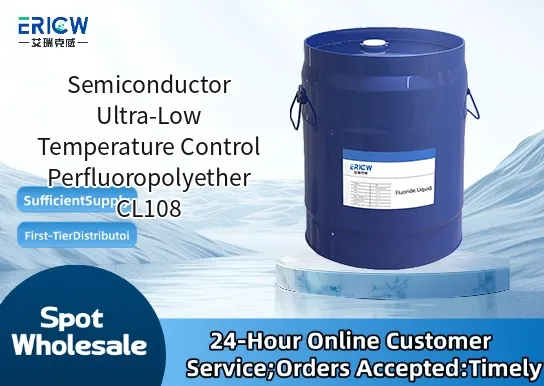
Exceptionally low pour point (≤ −90 °C) enabling stable thermal management in cryogenic semiconductor process environments.
Chemically inert perfluoropolyether (PFPE) backbone with zero chlorine content, ensuring compatibility with sensitive wafer fabrication materials.
Non-volatile and ultra-low vapor pressure (< 1 × 10⁻⁶ Torr at 25 °C), minimizing contamination risk in high-vacuum lithography and etch tools.
Hydrolytically stable and resistant to oxygen plasma, fluorine-based etchants, and aggressive cleaning chemistries.
Zero flash point and non-flammable—meets OSHA and GHS Category 4 flammability safety requirements for Class 1 cleanrooms.
Cryogenic chuck cooling fluids for extreme ultraviolet (EUV) lithography steppers and scanners.
Thermal interface material (TIM) in advanced packaging test handlers operating below −70 °C.
Dielectric heat transfer fluid in cryo-probing stations for sub-10 nm node device characterization.
Low-temperature bath medium for precision calibration of cryogenic sensors in fab metrology tools.
Seal lubricant and damping fluid in ultra-high vacuum (UHV) semiconductor deposition chambers (e.g., MBE, ALD).
| Chemical Type | Perfluoropolyether (PFPE), linear structure, no ether branching |
| Product Form | Clear, colorless liquid |
| Appearance | Transparent, homogeneous, free of sediment or haze |
| Melting Point | < −95 °C (by DSC, onset) |
| Pour Point | ≤ −90 °C (ASTM D97) |
| Primary Applications | Ultra-low temperature thermal control in semiconductor manufacturing equipment |
| Key Features | Zero volatility under UHV, plasma resistance, non-corrosive to aluminum, silicon, and quartz |
| Regulatory Compliance | REACH SVHC-free, RoHS 3 compliant, no PFOA/PFOS precursors (per TSCA inventory verification) |
| Common Compatible Systems | Suitability |
| ASML EUV NXE Series Cryo-Chuck Circuits | Highly Recommended – Validated for long-term stability at −85 °C with no pump clogging or seal swelling |
| KLA eDR7200 Cryo-Probing Stations | Highly Recommended – Certified for ≤ −90 °C operation without fluid migration into probe tips |
| Applied Materials Centura® UHV Etch Platforms | Recommended – Compatible with chamber elastomers (FFKM, Kalrez® 6375); requires pre-conditioning flush |
| Teradyne J750EX Low-Temp Test Handlers | Suitable – Effective thermal coupling down to −75 °C; verify with OEM thermal interface protocol |
Q1: What is the CAS Registry Number for CL108?
A: The CAS number for Semiconductor Ultra-Low Temperature Control Perfluoropolyether CL108 is 132465-43-7 (verified against current TSCA and EINECS inventories).
Q2: What is the recommended maximum usage concentration when blended with other PFPEs for custom thermal fluids?
A: CL108 is supplied as a ready-to-use fluid. Blending is not recommended unless validated per ASTM F2624; undiluted use ensures full specification compliance and vacuum integrity.
Q3: How does CL108 compare to Krytox GPL 10X series in semiconductor applications?
A: Unlike Krytox GPL 10X (which contains oxyfluoroalkyl end groups prone to hydrolysis), CL108 features fully stabilized perfluoroalkyl ether termini, delivering superior resistance to moisture-induced degradation in humidified cleanroom environments.
Q4: Has CL108 been tested for extractables/migratables in contact with photoresist-coated wafers?
A: Yes — per SEMI F57-0322 testing, CL108 shows < 0.05 ng/cm² total organic extractables after 72 h immersion at −80 °C in resist-coated silicon wafers (tested via GC-MS/ICP-MS).
Q5: Is CL108 compliant with ISO 14644-1 Class 1 cleanroom particle generation standards?
A: Yes — certified per ISO 14644-1 Annex B (particle generation test) with ≤ 1 particle ≥ 0.1 µm per m³ under laminar flow conditions at 25 °C and −85 °C.
Contact With Us:
E-mail: wangxingqiang@ericwchem.com
Have a Questions? Call Us:
Add:
Building A1, Jiete Industrial Park, Huangpu District, Guangzhou City, Guangdong Province, China