English
 Español
 tiếng việt
 русский
Zero ozone depletion potential (ODP = 0) and low global warming potential (GWP < 15).
Nonflammable, thermally stable, and chemically inert under standard operating conditions.
Low surface tension and excellent material compatibility with common elastomers and plastics.
Fast-drying, residue-free evaporation with no need for post-rinse in precision cleaning applications.
Designed for closed-loop vapor degreasing systems to minimize environmental release and operator exposure.
Final rinse solvent for aerospace components requiring ultra-low particle and ionic residue levels.
Cleaning agent for high-reliability electronics, including MEMS devices and optical sensor assemblies.
Carrier fluid for precision defluxing and flux residue removal in advanced SMT manufacturing.
Dielectric testing fluid for high-voltage insulation verification in power electronics modules.
Formulation base for specialty coatings and protective thin-film deposition processes.
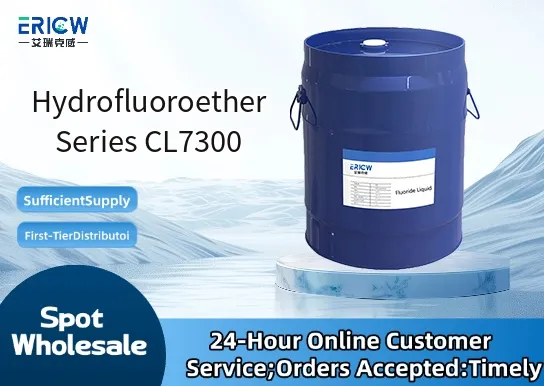
| Chemical Type | Hydrofluoroether (HFE), branched aliphatic structure |
| Product Form | Clear, colorless liquid |
| Appearance | Transparent, odorless liquid |
| Boiling Point (1 atm) | ~76–78 °C |
| Density (20 °C) | 1.34–1.36 g/cm³ |
| Primary Applications | Vapor degreasing, precision rinsing, dielectric testing, carrier fluid |
| Key Features | Nonflammable (ASTM D3278 Class IIIB), low toxicity (LC50 > 20,000 ppm), non-corrosive |
| Regulatory Compliance | REACH registered; compliant with EPA SNAP Program (Acceptable Substitute); not listed under TSCA Significant New Use Rules |
| Common Compatible Systems | Suitability |
| Standard Vapor Degreasing Units (e.g., CFC-113 / nPB replacement systems) | Highly Recommended – Fully compatible with stainless steel, aluminum, and fluoropolymer-lined tanks and condensers |
| Ultrasonic Cleaning Systems (low-frequency, 25–40 kHz) | Recommended – Effective at ambient temperature; avoid prolonged high-temp ultrasonics (>60 °C) |
| Batch Spray-in-Air Cabinets | Suitable – Requires ventilation control due to moderate volatility; compatible with polypropylene and EPDM seals |
| Carbon Adsorption Recovery Systems | Highly Recommended – High adsorption efficiency (>95%) and clean thermal desorption profile |
Q1: What is the CAS Registry Number for CL7300?
A: The CAS number for Hydrofluoroether Series CL7300 is 132138-65-5.
Q2: What is the recommended usage concentration when used as a rinse carrier or co-solvent?
A: CL7300 is typically used neat (100% concentration); when blended as a co-solvent (e.g., with alcohols or esters), recommended ratios range from 20–80% v/v depending on solvency requirements and process validation data.
Q3: How does CL7300 compare to HFE-7100 or HFE-7200 in terms of boiling point and materials compatibility?
A: CL7300 has a lower boiling point (~77 °C) than HFE-7100 (86 °C) and HFE-7200 (104 °C), enabling faster cycle times; it also exhibits superior compatibility with silicone elastomers and certain polyimide films compared to HFE-7200.
Q4: Are there any known migration or extraction concerns when CL7300 contacts medical-grade polymers such as PVC or polyurethane?
A: Extensive extractables testing per USP <87> and <88> shows negligible leachables (<0.1 ppm) from PVC, polyurethane, and silicone after 72-hour contact at 25 °C; long-term immersion (>1 week) is not recommended without application-specific validation.
Q5: Does CL7300 require special regulatory certification for use in EU electronics manufacturing?
A: CL7300 is REACH registered and fully compliant with RoHS 3 (2015/863/EU); it contains no SVHCs above threshold and is exempt from SCIP reporting when used as a processing chemical (not placed on market as substance/mixture).
Contact With Us:
E-mail: wangxingqiang@ericwchem.com
Have a Questions? Call Us:
Add:
Building A1, Jiete Industrial Park, Huangpu District, Guangzhou City, Guangdong Province, China