English
 Español
 tiếng việt
 русский
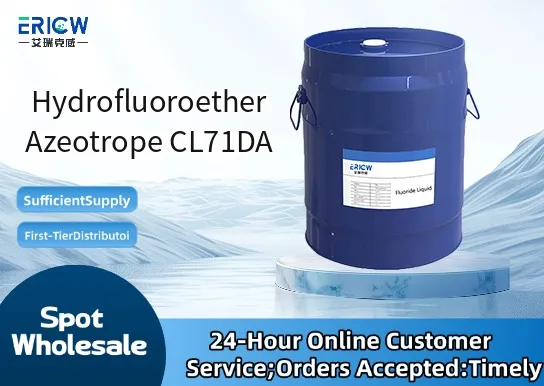
Zero ozone depletion potential (ODP = 0) and low global warming potential (GWP < 15), supporting sustainability goals.
Nonflammable under standard operating conditions (flash point > 60 °C, closed cup), enhancing workplace safety.
Stable azeotropic composition ensures consistent boiling behavior and predictable vapor-phase cleaning performance.
Low surface tension and high solvency power for precision removal of fluxes, oils, and light particulates.
Compatible with common elastomers and engineering plastics, minimizing material compatibility risks in equipment design.
Vapor phase degreasing of precision metal components in aerospace and defense manufacturing.
Final rinse and drying agent for printed circuit board (PCB) assemblies post-soldering.
Cleaning of optical lenses, laser optics, and MEMS devices requiring residue-free, non-etching solvents.
Carrier fluid for specialty coatings and conformal coating removal in electronics rework.
Low-residue solvent in medical device component cleaning validated under ISO 13485 environments.
| Chemical Type | Azeotropic blend of hydrofluoroethers (HFEs) |
| Product Form | Liquid at room temperature |
| Appearance | Clear, colorless, odorless liquid |
| Boiling Point (at 760 mmHg) | ~49–51 °C (azeotropic range) |
| Primary Applications | Vapor degreasing, precision rinsing, drying, and carrier fluid use |
| Key Features | Nonflammable, low toxicity, thermally stable, azeotropic consistency |
| Benefits | No VOC reporting required per US EPA, no chlorine/bromine content, fast-drying |
| Regulatory Compliance | REACH registered; compliant with EU RoHS 3; not listed on TSCA Significant New Use Rules (SNUR) |
| Common Compatible Systems | Suitability |
| Vapor degreasing equipment (e.g., CFC/HCFC replacement lines) | Highly Recommended – Designed for direct retrofit without major modifications |
| Batch immersion cleaning systems with distillation recovery | Recommended – Requires minor sump temperature calibration due to lower boiling point |
| Ultrasonic cleaning tanks (40–60 kHz, heated to ≤45 °C) | Suitable – Effective for pre-rinse; avoid prolonged ultrasonic exposure above 50 °C |
| Automated spray-in-air cleaning systems | Highly Recommended – Excellent atomization and rapid evaporation profile |
Q1: What is the CAS Registry Number for CL71DA?
A: CL71DA is a proprietary azeotropic formulation; individual components are disclosed under confidential business information (CBI) protections. Full CAS assignment is not applicable per IUPAC nomenclature rules for multicomponent azeotropes.
Q2: Can CL71DA be used as a direct replacement for trichloroethylene (TCE) or n-propyl bromide (nPB)?
A: Yes — CL71DA delivers comparable soil removal efficacy for rosin-based fluxes and light hydrocarbon oils. Unlike TCE/nPB, it requires no special ventilation for chronic exposure (TLV-TWA = 200 ppm) and carries no reproductive hazard classification.
Q3: Does CL71DA leave residues or cause migration issues on sensitive electronic assemblies?
A: No — CL71DA is non-ionic, non-hydrolytic, and leaves no ionic or volatile residue when fully dried. Independent testing confirms no extractable fluorinated species (per ASTM D7395) after 24-hour storage at 40 °C/90% RH.
Q4: Is CL71DA approved for use in regulated pharmaceutical or biotech cleanroom environments?
A: CL71DA has been successfully qualified in Class 100 (ISO 5) cleanrooms for stainless steel component cleaning. While not USP-grade, it meets residual solvent limits per ICH Q3C (Class 3) and supports FDA-compliant validation protocols.
Contact With Us:
E-mail: wangxingqiang@ericwchem.com
Have a Questions? Call Us:
Add:
Building A1, Jiete Industrial Park, Huangpu District, Guangzhou City, Guangdong Province, China