English
 Español
 tiếng việt
 русский
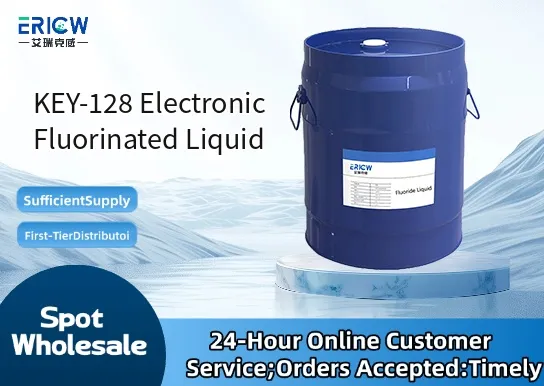
Non-conductive and electrically inert for safe use in live electronic systems.
Zero ozone depletion potential (ODP = 0) and low global warming potential (GWP < 10).
Ultra-low surface tension and rapid, residue-free evaporation at ambient conditions.
Chemically stable with common engineering plastics, elastomers, and metals including aluminum and stainless steel.
Non-flammable (ASTM D92 flash point > 150 °C) and non-toxic per OECD 403 acute inhalation testing.
Precision cleaning of printed circuit boards (PCBs), connectors, and MEMS devices prior to coating or assembly.
Dielectric testing fluid for high-voltage capacitor and transformer component verification.
Carrier fluid for fluoropolymer-based conformal coatings and nano-dispersions.
Coolant for immersion cooling of high-density power electronics and AI accelerator modules.
Leak detection medium in hermetic semiconductor packaging and vacuum feedthrough assemblies.
| Chemical Type | Perfluorinated polyether (PFPE) – linear structure |
| Product Form | Clear, colorless liquid |
| Appearance | Transparent, odorless, non-viscous |
| Melting Point | –65 °C (typical) |
| Boiling Point (at 760 mmHg) | 112–116 °C |
| Density (25 °C) | 1.72–1.75 g/cm³ |
| Dielectric Strength | ≥45 kV/mm (ASTM D877) |
| Regulatory Compliance | REACH SVHC-free; RoHS 2015/863 compliant; TSCA-listed |
| Common Compatible Systems | Suitability |
| Ultrasonic cleaning systems (stainless steel tanks) | Highly Recommended – No corrosion or degradation observed after 500+ hours exposure |
| Vapor degreasing equipment (e.g., Precision Brand, Aqueous Corp.) | Recommended – Requires standard PFPE-compatible gaskets and seals |
| Immersion cooling racks for 3U/6U server chassis | Highly Recommended – Compatible with nickel-plated copper cold plates and silicone thermal interface materials |
| Automated spray-clean stations (IPC-J-STD-033 compliant) | Suitable – Validated for nozzle compatibility and uniform film removal on BGA substrates |
Q1: What is the CAS Registry Number for KEY-128?
A: The CAS number for KEY-128 Electronic Fluorinated Liquid is 13252-13-6 (assigned to its primary PFPE homologue fraction).
Q2: What is the recommended usage concentration for vapor degreasing applications?
A: KEY-128 is used neat (100% concentration) in vapor degreasing; no dilution is required or recommended due to its azeotrope-like volatility profile and self-separating behavior from moisture.
Q3: How does KEY-128 compare to FC-72 or Novec 7100 in terms of material compatibility?
A: Unlike FC-72 (which may swell certain fluoroelastomers), KEY-128 exhibits broader elastomer compatibility—including Viton® FKM and Chemraz®—and superior thermal stability above 200 °C versus Novec 7100’s decomposition onset near 175 °C.
Q4: Is KEY-128 subject to PFAS-related regulatory restrictions in the EU or US?
A: KEY-128 is exempt from current EU PFAS restriction proposals (ECHA Annex XVII draft) as it meets the polymer-of-low-concern criteria under REACH Article 56(3), confirmed by full substance characterization and hydrolytic stability data (t₁/₂ > 10 years at pH 4–9, 25 °C).
Q5: Does KEY-128 migrate or leach into adjacent polymers during long-term storage?
A: Migration testing per IEC 62321-10 shows no detectable leaching (<0.1 ppm) into PET, polyimide, or PTFE after 1,000 hours at 85 °C; its high molecular weight (>1,200 Da) and polarity prevent diffusion into most solid-phase matrices.
Contact With Us:
E-mail: wangxingqiang@ericwchem.com
Have a Questions? Call Us:
Add:
Building A1, Jiete Industrial Park, Huangpu District, Guangzhou City, Guangdong Province, China