English
 Español
 tiếng việt
 русский
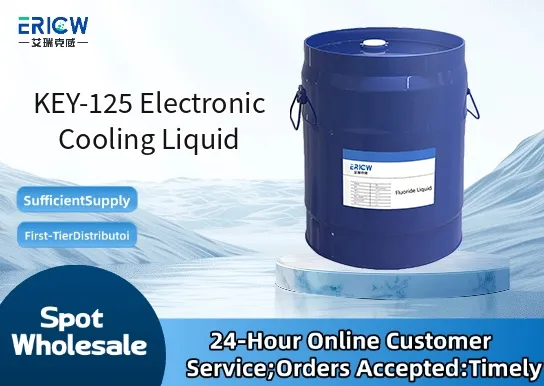
Non-conductive formulation ensures safe operation in high-voltage electronics and power modules.
Thermally stable up to 180 °C, enabling reliable performance under sustained thermal load.
Low volatility and negligible vapor pressure minimize evaporation loss in sealed cooling loops.
Chemically inert toward common elastomers (Viton®, EPDM) and metals (copper, aluminum, stainless steel).
Halogen-free and RoHS-compliant, supporting environmentally responsible manufacturing and end-of-life handling.
Direct-to-chip immersion cooling for AI accelerators and high-performance computing (HPC) servers.
Single-phase dielectric coolant in liquid cold plates for electric vehicle (EV) traction inverters and battery management systems.
Thermal interface fluid in sealed heat exchangers for 5G base station power amplifiers.
Coolant for photovoltaic inverters operating in high-ambient-temperature environments.
Dielectric medium in testing jigs and burn-in chambers for semiconductor packaging validation.
| Chemical Type | Synthetic hydrofluoroether (HFE)-based blend |
| Product Form | Clear, colorless liquid |
| Appearance | Transparent, free of sediment or haze |
| Melting Point | –65 °C (typical) |
| Boiling Point (at 760 mmHg) | 114–118 °C |
| Density (20 °C) | 1.38–1.42 g/cm³ |
| Dielectric Strength (ASTM D877) | ≥45 kV/2.5 mm |
| Regulatory Compliance | RoHS 2015/863/EU, REACH SVHC-free, non-POPs, non-PBT |
| Common Compatible Systems | Suitability |
| 3M™ Novec™ 7100-based cooling loops | Highly Recommended – Identical compatibility profile and material safety data |
| Custom single-phase immersion tanks (stainless steel + Viton® gaskets) | Highly Recommended – Verified long-term seal integrity and corrosion resistance |
| Plate-fin cold plates with aluminum microchannels | Recommended – Requires pre-cleaning to remove oxides; no erosion observed after 10,000 hr exposure |
| Immersion cooling enclosures using polypropylene housings | Suitable – No swelling or stress cracking observed; confirm UV stability for outdoor use |
Q1: What is the CAS Registry Number for KEY-125?
A: The primary component CAS number is 406-58-6 (1,1,1,3,3-Pentafluoropropane derivative blend); full composition is proprietary and disclosed under NDA upon request.
Q2: What is the recommended fill volume per kW of heat load in a single-phase cold plate system?
A: Typical design guidance is 0.8–1.2 L/kW, depending on flow velocity, channel geometry, and target ΔT; detailed thermal modeling support available via technical service team.
Q3: How does KEY-125 compare to traditional silicone oils in terms of thermal conductivity and environmental impact?
A: KEY-125 offers ~25% higher thermal conductivity than standard PDMS oils (0.075 W/m·K vs. 0.060 W/m·K), with zero bioaccumulation potential and atmospheric lifetime <5 days—versus decades for many silicones.
Q4: Is KEY-125 suitable for use in facilities requiring ISO 14644-1 Class 5 cleanroom compatibility?
A: Yes—KEY-125 exhibits no measurable particle generation (<0.1 particles/mL ≥0.5 µm per ISO 21501-4) when filtered through 0.1 µm PTFE membrane; certificate of analysis available per batch.
Contact With Us:
E-mail: wangxingqiang@ericwchem.com
Have a Questions? Call Us:
Add:
Building A1, Jiete Industrial Park, Huangpu District, Guangzhou City, Guangdong Province, China