English
 Español
 tiếng việt
 русский
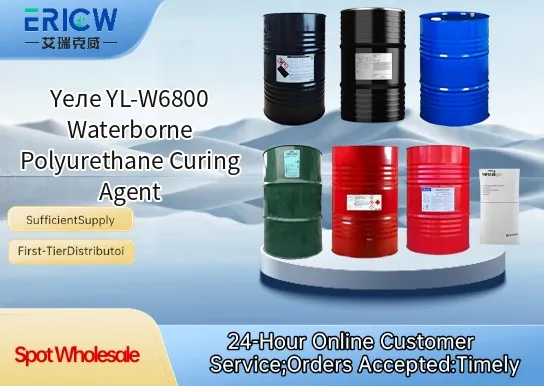
Low-VOC, water-based formulation compliant with stringent global environmental regulations.
Excellent compatibility with common waterborne polyurethane dispersions (PUDs) and acrylic emulsions.
Fast ambient-cure capability with improved film hardness and crosslink density within 24–48 hours.
Enhanced chemical resistance to water, alkali, and mild solvents after full cure.
Stable dispersion with low viscosity, enabling easy handling and spray application without dilution.
Waterborne wood coatings for furniture and interior joinery.
High-performance industrial maintenance coatings for metal substrates.
Eco-friendly leather finishing topcoats requiring flexibility and abrasion resistance.
Architectural interior wall coatings demanding low odor and rapid occupancy readiness.
Flexible packaging adhesives where FDA-compliant curing is required.
| Chemical Type | Aliphatic polyisocyanate crosslinker (HDI-based) |
| Product Form | Aqueous dispersion |
| Appearance | Transparent to slightly opalescent liquid |
| Solids Content | 35 ± 2 wt% |
| pH (10% aqueous solution) | 7.5 – 8.5 |
| Viscosity (25°C, mPa·s) | 80 – 150 (Brookfield RVT, spindle #3, 20 rpm) |
| Storage Stability | ≥6 months at 5–30°C in sealed container |
| Primary Functional Group | Aliphatic isocyanate (–NCO) |
Q1: What types of waterborne polyurethane dispersions (PUDs) is YL-W6800 compatible with?
A: YL-W6800 is formulated for broad compatibility with anionic and non-ionic aromatic and aliphatic PUDs commonly used in coatings, adhesives, and sealants. Compatibility should be verified experimentally for each specific PUD system due to variations in particle size, charge density, and functional group distribution.
Q2: How does YL-W6800 affect the pot life and film formation of waterborne PU systems?
A: As a latent or slow-reacting curing agent, YL-W6800 extends working time at ambient temperatures while enabling efficient crosslinking upon mild thermal activation (e.g., ambient drying followed by low-temperature baking). Film formation remains cohesive and defect-free when applied within recommended formulation guidelines.
Q3: Can YL-W6800 be used in applications requiring low-VOC or zero-NMP formulations?
A: Yes — YL-W6800 is inherently free of NMP, DMF, and other high-boiling polar aprotic solvents. It supports formulation of low-VOC, aqueous-based systems compliant with evolving environmental and occupational health requirements for industrial and architectural coatings.
Q4: Is post-curing required to achieve optimal chemical resistance and mechanical performance?
A: While initial film formation occurs during ambient drying, full crosslink development and peak performance — especially in hardness, solvent resistance, and tensile strength — are typically achieved after a controlled thermal post-cure step (e.g., 60–80 °C for 20–60 minutes), depending on film thickness and substrate.
Contact With Us:
E-mail: wangxingqiang@ericwchem.com
Have a Questions? Call Us:
Add:
Building A1, Jiete Industrial Park, Huangpu District, Guangzhou City, Guangdong Province, China