English
 Español
 tiếng việt
 русский
Enhanced thermal stability for high-performance epoxy systems operating up to 180 °C.
Low viscosity (250–400 mPa·s at 25 °C) enabling excellent processability and filler wetting.
Reduced exotherm peak temperature during cure, improving safety in thick-section casting.
Good compatibility with standard bisphenol-A and novolac epoxy resins.
Improved humidity resistance compared to conventional aliphatic amines, supporting outdoor applications.
High-voltage electrical encapsulants and potting compounds.
Structural adhesives for aerospace and automotive composites.
Thick-section castings for industrial tooling and dielectric components.
UV-resistant protective coatings for wind turbine blades and marine structures.
Electronics underfill and conformal coating formulations requiring low stress and high Tg.
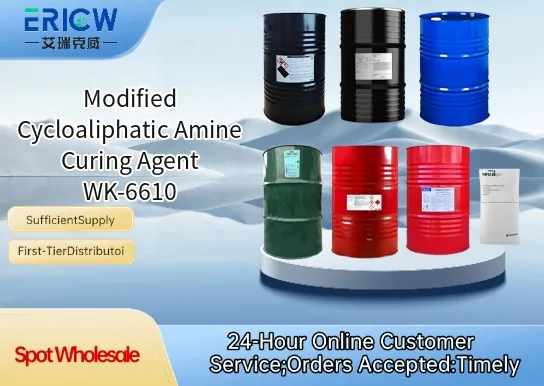
| Chemical Type | Modified cycloaliphatic amine |
| Product Form | Liquid |
| Appearance | Clear, pale yellow liquid |
| Primary Applications | Epoxy resin curing agent for high-performance composites and electrical insulation |
| Key Features | Low volatility, non-crystallizing, moderate reactivity |
| Benefits | Extended pot life, reduced blush tendency, improved interlaminar shear strength |
| Storage Stability | ≥12 months at 25 °C in sealed containers |
| Reactivity Profile | Medium-cure speed; full cure achievable at 80–120 °C |
Q1: What are the key advantages of WK-6610 compared to conventional aliphatic amines?
A: WK-6610 offers improved pot life and reduced exotherm versus standard aliphatic amines, while maintaining rapid ambient-cure capability. Its modified cycloaliphatic structure enhances thermal stability and chemical resistance in the cured epoxy network without requiring elevated post-cure.
Q2: How does WK-6610 perform in high-humidity or low-temperature curing conditions?
A: WK-6610 demonstrates good reactivity and film formation under moderate humidity (up to 80% RH) and at temperatures as low as 10°C, making it suitable for field-applied protective coatings where environmental control is limited.
Q3: Is WK-6610 compatible with common epoxy resins used in industrial coatings and composites?
A: Yes — WK-6610 is broadly compatible with standard DGEBA-type epoxies, novolac epoxies, and many solid and liquid bisphenol-A/F resins. It is also formulated to minimize amine bloom and surface tackiness in thick-section applications.
Q4: What safety and handling considerations apply to WK-6610?
A: As with most amine-based hardeners, WK-6610 is an irritant to skin and eyes and should be handled using appropriate PPE (gloves, goggles, ventilation). It has lower volatility than many aliphatic amines, reducing inhalation risk during mixing and application.
Contact With Us:
E-mail: wangxingqiang@ericwchem.com
Have a Questions? Call Us:
Add:
Building A1, Jiete Industrial Park, Huangpu District, Guangzhou City, Guangdong Province, China