English
 Español
 tiếng việt
 русский
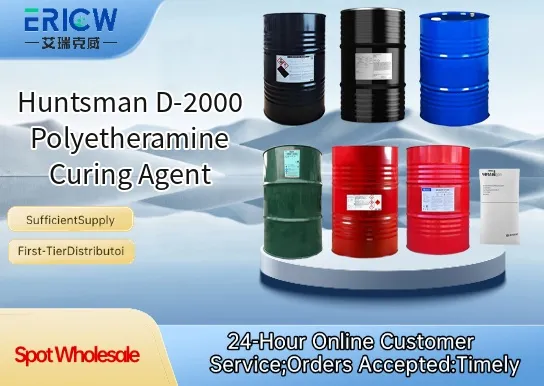
Low-viscosity liquid enabling easy handling and efficient mixing with epoxy resins.
Fast ambient-cure capability without requiring elevated temperatures or post-cure cycles.
Excellent flexibility and impact resistance in cured epoxy systems.
Superior moisture tolerance during application, reducing sensitivity to humidity-induced defects.
Low color and low volatility, supporting high-gloss finishes and improved workplace safety.
Structural adhesives for aerospace and automotive bonding.
High-performance coatings for marine and offshore infrastructure.
Electrical encapsulants and potting compounds for power electronics.
Composite matrix resins in wind turbine blade manufacturing.
Repair mortars and grouts for civil engineering applications.
| Chemical Type | Polyetheramine (tertiary amine-terminated) |
| Product Form | Clear, light-yellow liquid |
| Appearance | Homogeneous, free of sediment or haze |
| Amine Value | 190–210 mg KOH/g |
| Viscosity (25°C) | 150–250 cP |
| Specific Gravity (25°C) | 0.94–0.97 g/cm³ |
| Reactive Amine Hydrogen Equivalent Weight | ~105–115 g/eq |
| Storage Stability | Stable for ≥12 months at 15–25°C in sealed containers |
Q1: What is the primary function of D-2000 in epoxy systems?
A: D-2000 is a polyetheramine-based curing agent designed to react with epoxy resins to form flexible, tough, and chemically resistant thermoset networks—particularly valued for enhanced low-temperature cure performance and reduced exotherm in thick-section applications.
Q2: How does D-2000 compare to traditional aliphatic amines in terms of handling and safety?
A: D-2000 exhibits significantly lower volatility and reduced skin sensitization potential compared to many conventional aliphatic amines, contributing to improved workplace safety and easier handling without requiring specialized ventilation under standard industrial conditions.
Q3: Is D-2000 suitable for high-performance coatings requiring flexibility and impact resistance?
A: Yes—its polyether backbone imparts inherent flexibility and resilience to cured films, making it well-suited for protective coatings on substrates subject to thermal cycling, mechanical stress, or substrate movement, such as concrete flooring and industrial maintenance systems.
Q4: Can D-2000 be blended with other amine or phenalkamine curing agents?
A: D-2000 is generally compatible with many common epoxy co-curing agents and can be formulated into hybrid systems to balance reactivity, pot life, and final film properties—though compatibility and stoichiometric adjustments should be verified experimentally for each specific formulation.
Contact With Us:
E-mail: wangxingqiang@ericwchem.com
Have a Questions? Call Us:
Add:
Building A1, Jiete Industrial Park, Huangpu District, Guangzhou City, Guangdong Province, China