English
 Español
 tiếng việt
 русский
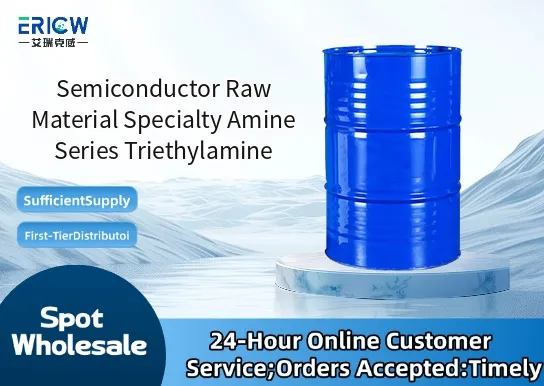
Ultra-high purity (≥99.99% GC), rigorously controlled for trace metal content (Na, K, Fe, Cu < 10 ppb) to prevent semiconductor device contamination.
Low volatility and optimized vapor pressure profile for precise vapor-phase delivery in CVD/ALD processes.
Consistent batch-to-batch reproducibility with certified analytical reports (CoA) per lot, including NMR and GC-MS verification.
Stabilized formulation with proprietary antioxidant system to inhibit amine oxidation and extend shelf life under inert storage.
Manufactured in ISO 9001- and ISO 14001-certified cleanroom facilities compliant with SEMI S2/S8 safety and environmental standards.
Catalyst and ligand precursor in atomic layer deposition (ALD) of high-k dielectric films (e.g., Al₂O₃, HfO₂).
Reducing agent and complexing ligand in solution-based synthesis of metal-organic precursors for copper interconnect metallization.
pH modulator and co-catalyst in photoresist development formulations for advanced lithography (EUV and ArF immersion).
Surface passivation additive in post-CMP cleaning chemistries to suppress metal ion redeposition.
Key reagent in the synthesis of nitrogen-doped carbon nanomaterials used in next-generation semiconductor packaging substrates.
| Chemical Type | Tertiary aliphatic amine |
| Product Form | Liquid (bulk or sealed ampoule) |
| Appearance | Colorless to pale yellow clear liquid |
| Melting Point | −114 °C |
| Boiling Point (at 760 mmHg) | 89 °C |
| Density (20 °C) | 0.726–0.729 g/cm³ |
| Primary Applications | ALD/CVD precursor synthesis, photoresist additives, CMP chemistry, surface functionalization |
| Regulatory Compliance | REACH registered; RoHS 2.0 compliant; no SVHC on ECHA Candidate List (as of latest update) |
| Common Compatible Systems | Suitability |
| ALD Tools (e.g., ASM Eagle XP8, Oxford FlexAL) | Highly Recommended – Fully compatible with standard vaporizer configurations and stainless-steel delivery lines |
| Photoresist Development Baths (TMAH-based) | Recommended – Demonstrated stability in alkaline developers at ≤0.5 wt% concentration |
| CMP Slurry Systems (Colloidal Silica, Ceria) | Suitable – Effective as surface modifier without destabilizing abrasive dispersion |
| Organometallic Synthesis Reactors (Schlenk, glovebox) | Highly Recommended – Inert-atmosphere handling validated; no observed side reactions with common metal halides |
Q1: What is the CAS Registry Number for this grade of triethylamine?
A: The CAS number is 121-44-8. This specific semiconductor-grade material carries an additional lot-specific purity designation and trace metal certification beyond standard commercial triethylamine.
Q2: What is the recommended dosage range when used in ALD precursor synthesis?
A: Typical stoichiometric ratios range from 1.2:1 to 3:1 (triethylamine : metal halide), depending on the target complex. Exact optimization requires empirical testing under process-relevant conditions; application support documentation is provided with each shipment.
Q3: How does this specialty amine differ from technical-grade triethylamine in terms of extractables and leachables?
A: Unlike technical grades, this product undergoes multi-stage sub-micron filtration and fractional distillation under nitrogen, reducing volatile organic impurities (VOCs) and non-volatile residues by >99%. Extractables testing per SEMI F57 shows <5 ng/cm² total organics after exposure to 18.2 MΩ·cm DI water at 60 °C for 24 h.
Q4: Is this material certified for use in Class 10 cleanroom environments?
A: Yes — all packaging (including fluoropolymer-lined bottles and crimp-sealed glass ampoules) is certified for Class 10 (ISO 4) cleanroom use per ISO 14644-1. Particulate testing per SEMI F32 confirms ≤1 particle ≥0.5 μm per mL in dispensed liquid.
Contact With Us:
E-mail: wangxingqiang@ericwchem.com
Have a Questions? Call Us:
Add:
Building A1, Jiete Industrial Park, Huangpu District, Guangzhou City, Guangdong Province, China