English
 Español
 tiếng việt
 русский
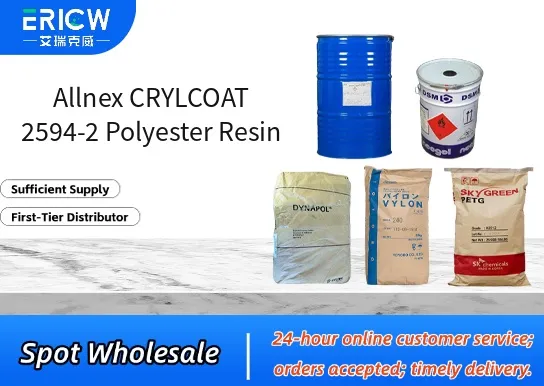
High-gloss, excellent flow and leveling for premium surface aesthetics.
Outstanding weather resistance and UV stability for long-term outdoor performance.
Excellent chemical resistance to solvents, acids, and alkaline cleaners.
Optimized reactivity for efficient curing with TGIC-free crosslinkers.
Consistent batch-to-batch reproducibility and low volatile organic content (VOC).
Architectural aluminum extrusions for façades and curtain walls.
Automotive exterior trim and non-structural components.
Outdoor furniture and garden equipment coatings.
Consumer electronics enclosures requiring durable decorative finishes.
| Chemical Type | Carboxyl-functional saturated polyester |
| Product Form | Powder (free-flowing granules) |
| Appearance | White to off-white free-flowing powder |
| Acid Value (mg KOH/g) | 28–32 |
| Gardner Color | ≤ 2 |
| Melt Viscosity (160°C, Pa·s) | 3,500–5,500 |
| Particle Size (D50, μm) | 30–40 |
| Primary Applications | High-performance TGIC-free and HAA-cured powder coatings |
Q1: What is the primary application of CRYLCOAT 2594-2 in powder coatings?
A: CRYLCOAT 2594-2 is a carboxyl-functional polyester resin specifically designed for use in TGIC-free, high-gloss, and semi-gloss thermosetting powder coating systems, particularly where excellent flow, leveling, and long-term weather resistance are required.
Q2: Which curing agents is CRYLCOAT 2594-2 compatible with?
A: This resin is formulated for use with standard epoxy-functional hardeners such as glycidyl ether-based crosslinkers (e.g., Araldite PT810), and is also suitable for hybrid systems with acrylic or other co-resins when optimizing performance attributes like flexibility or UV stability.
Q3: How does CRYLCOAT 2594-2 perform under outdoor exposure conditions?
A: As a medium-to-high molecular weight, carboxyl-terminated polyester, it delivers robust resistance to UV degradation, chalking, and gloss loss—making it well-suited for architectural and industrial applications exposed to prolonged sunlight and environmental stress.
Q4: Is CRYLCOAT 2594-2 suitable for thin-film or low-cure applications?
A: While optimized for standard cure schedules (e.g., 180–200 °C for 10–15 minutes), it can be adapted to lower-cure formulations through resin blending or hardener selection—but achieving full crosslink density at significantly reduced temperatures may require formulation adjustments and performance validation.
Contact With Us:
E-mail: wangxingqiang@ericwchem.com
Have a Questions? Call Us:
Add:
Building A1, Jiete Industrial Park, Huangpu District, Guangzhou City, Guangdong Province, China