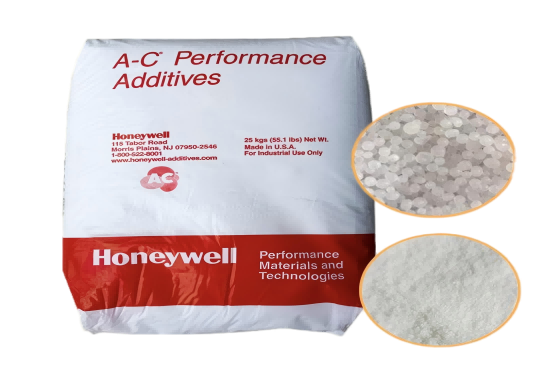
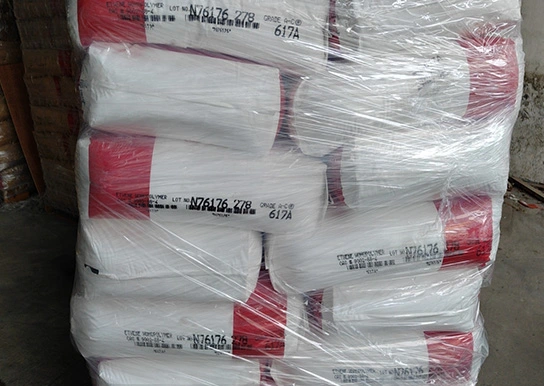
Features Of Honeywell ethylene-maleic anhydride grafted polymer wax powder A-C 575P
Superior Compatibility: Boosts interlayer bonding strength in plastics and composites, optimizing material performance.
Enhanced Adhesion: Improves bonding in polar materials for strong, reliable adhesion.
Processing Efficiency: Enhances plastic melt flow and dispersion, increasing production throughput.
Mechanical Reinforcement: Strengthens composite durability and mechanical properties, extending service life.
Multifunctional Use: Suitable for plastics, composites, coatings, and adhesives.
Eco-Safe: Complies with international environmental standards, non-toxic for industrial applications.
Typical Applications Of Honeywell ethylene-maleic anhydride grafted polymer wax powder A-C 575P
Plastic Processing: Improves compatibility, surface quality, and processing performance of plastic products.
Composites: Enhances interlayer bonding strength and mechanical properties of composite materials.
Coatings: Optimizes adhesion and wear resistance for improved surface performance.
Adhesives: Strengthens cohesion and substrate bonding in adhesive formulations.
Industrial: Versatile solutions for rubber, inks, and functional material modification.
Specifications Of Honeywell ethylene-maleic anhydride grafted polymer wax powder A-C 575P
Chemical Type | Ethylene-Maleic Anhydride Grafted Polymer |
Appearance | Powder |
Brand | Honeywell |
Model | A-C 575P |
Melting Point | Approx. 104℃ |
Density | 0.93 g/cm³ |
Acid Value | 45 mg KOH/g |
Packaging | 20kg/bag |
Origin | USA |
Honeywell ethylene-maleic anhydride grafted polymer wax powder A-C 575P – Frequently Asked Questions (FAQ)
Q1: What is the primary functional role of A-C 575P in polymer and coating formulations?
A: A-C 575P functions primarily as a compatibilizer and dispersing aid, leveraging its maleic anhydride groups to interact with polar substrates or fillers while its ethylene backbone provides compatibility with non-polar polymers such as polyolefins. It enhances interfacial adhesion, improves pigment dispersion stability, and contributes to controlled surface migration for matting or slip effects.
Q2: Is A-C 575P suitable for use in food-contact or medical-grade applications?
A: A-C 575P is not pre-qualified for direct food-contact or regulated medical applications. Its suitability depends on final formulation testing, regulatory review, and compliance with applicable regional requirements. Customers must conduct full migration, extractables, and biocompatibility assessments as appropriate for their intended end-use.
Q3: How is A-C 575P typically incorporated into thermoplastic compounds?
A: A-C 575P is commonly added during melt compounding—either directly into the extruder feed throat or via side-stuffer—due to its thermal stability up to typical polyolefin processing temperatures. It disperses readily in molten polymer matrices and does not require pre-dissolution. Dosage depends on formulation requirements but is generally used at low concentrations relative to the base resin.
Q4: Does A-C 575P offer any performance advantages over ungrafted polyethylene waxes?
A: Yes—its maleic anhydride grafting imparts significantly improved polarity and reactivity compared to standard PE waxes. This enables stronger interactions with pigments, fillers, and polar resins, resulting in better dispersion, reduced agglomeration, enhanced gloss control in coatings, and improved mechanical property retention in filled composites.
 English
 Español
 tiếng việt
 русский