English
 Español
 tiếng việt
 русский
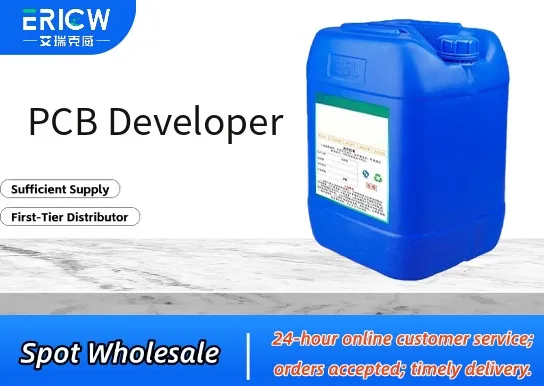
High selectivity for photoresist development with minimal undercut and excellent line edge definition.
Low volatility and stable performance across extended bath life—reduces drag-out and replenishment frequency.
Non-corrosive to copper, tin, and nickel surfaces—preserves conductor integrity during fine-line PCB manufacturing.
pH-buffered formulation ensures consistent development rate and repeatability under varying temperature and concentration conditions.
Free of halogenated solvents and heavy metals—designed to support RoHS 3 and REACH-compliant production environments.
Inner-layer and outer-layer imaging for multilayer rigid PCBs (up to 32 layers).
Advanced HDI (High-Density Interconnect) boards requiring ≤50 µm line/space resolution.
Flexible printed circuits (FPCs) using dry-film and liquid photoimageable solder masks.
IC substrates and embedded substrate applications demanding ultra-low residue and high cleanliness.
Automotive and aerospace PCBs requiring IPC-6012 Class 2 & 3 process compliance.
| Chemical Type | Aqueous alkaline solution (non-solvent-based) |
| Product Form | Concentrated liquid (ready-to-dilute) |
| Appearance | Clear, pale yellow to amber liquid |
| Typical Working Concentration | 0.8–1.2% v/v in deionized water |
| pH (1% aqueous solution, 25°C) | 12.4–12.8 |
| Density (20°C) | 1.08–1.12 g/cm³ |
| Primary Applications | Development of negative-tone dry film resists (e.g., DuPont Riston®, Asahi HTR®) and liquid photoresists |
| Regulatory Compliance | RoHS 3 (2015/863/EU), REACH SVHC-free, Prop 65 compliant, non-PFAS |
| Common Compatible Systems | Suitability |
| Horizontal conveyor spray developers (e.g., Orbotech, Screen, MPM) | Highly Recommended – Optimized for uniform spray pressure and dwell time control |
| Batch immersion systems (manual or semi-automated) | Recommended – Requires agitation and temperature monitoring (26–30°C) |
| Inline AOI-coupled develop-etch-strip lines | Suitable – Low foam generation prevents sensor interference; compatible with inline conductivity/pH monitoring |
| Recirculating filtration systems with 5–10 µm bag filters | Highly Recommended – Minimal particulate formation extends filter life and maintains bath clarity |
Q1: What is the CAS Registry Number for PCB Developer?
A: The CAS number is 9003-39-8 (generic reference for proprietary alkaline developer blend); full composition disclosure is provided under NDA per customer request.
Q2: What is the recommended working concentration and replenishment rate?
A: Use at 0.9–1.1% v/v in DI water (conductivity target: 8–12 mS/cm); replenish at 80–120 mL/m² of panel area processed, adjusted based on resist type and throughput.
Q3: How does PCB Developer compare to traditional sodium carbonate-based developers?
A: It offers superior resist dissolution kinetics, narrower process window tolerance, reduced micro-roughness on developed copper, and eliminates carbonate scaling in recirculation loops.
Q4: Is PCB Developer subject to migration or leaching into final PCB assemblies?
A: No detectable ionic residue remains post-rinse and hot-air drying (verified by IPC-TM-650 2.3.25B ion chromatography); meets IPC-A-600G cleanliness requirements for Class 3 assemblies.
Q5: Does PCB Developer require special handling or disposal considerations?
A: Classified as non-hazardous for transport (UN3082, PG III not applicable); neutralization prior to wastewater discharge is required per local pretreatment guidelines (pH 6–9, TDS < 2500 ppm).
Contact With Us:
E-mail: wangxingqiang@ericwchem.com
Have a Questions? Call Us:
Add:
Building A1, Jiete Industrial Park, Huangpu District, Guangzhou City, Guangdong Province, China