English
 Español
 tiếng việt
 русский
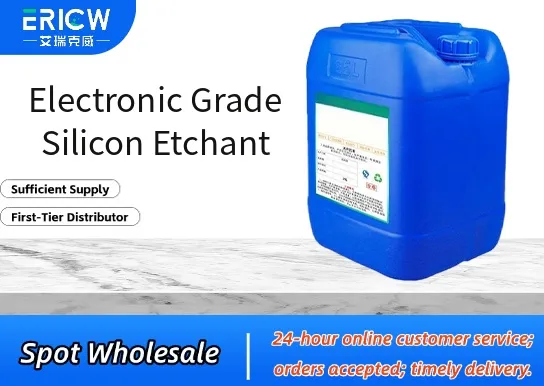
Ultra-low metallic impurity content (<1 ppb for Na, K, Fe, Cu, Ni, Cr, Zn, Al), meeting SEMI C12 and ISO 14644-1 Class 1 cleanroom requirements.
Consistent etch rate control (±3% batch-to-batch variation) enabled by rigorous in-process QC and lot traceability.
Non-hydrofluoric acid (non-HF) formulation based on buffered ammonium fluoride chemistry—reducing occupational exposure risk and easing EHS compliance.
Stable shelf life of ≥12 months when stored at 15–25°C in original sealed HDPE container; no phase separation or precipitation observed.
Optimized surface passivation to minimize post-etch silicon roughness (Ra < 0.3 nm) and suppress pitting on (100) and (111) wafers.
Front-end-of-line (FEOL) gate oxide removal and silicon recess etching in advanced CMOS node fabrication (≤7 nm).
MEMS device release etching for high-aspect-ratio silicon structures, including accelerometers and gyroscopes.
SOI wafer handle layer thinning and buried oxide (BOX) profile tuning prior to device layer transfer.
Post-CMP silicon residue cleaning and native oxide stripping in 3D IC and TSV integration processes.
Research & development applications requiring precise, repeatable silicon isotropic etching under ambient temperature conditions.
| Chemical Type | Buffered ammonium fluoride (NH₄F/NH₃/H₂O) with proprietary stabilizers |
| Product Form | Aqueous solution, ready-to-use |
| Appearance | Clear, colorless liquid |
| pH (25°C) | 8.2 ± 0.3 |
| Primary Applications | Silicon, silicon dioxide, and silicon nitride selective etching in microelectronics |
| Key Features | Non-corrosive to stainless steel and quartz; compatible with standard PFA and fluoropolymer wet benches |
| Benefits | Eliminates need for HF handling infrastructure; reduces wastewater neutralization burden |
| Regulatory Compliance | REACH SVHC-free; RoHS 2015/863 compliant; SDS available per GHS Rev. 7 |
| Common Compatible Systems | Suitability |
| SEMI-standard single-wafer spin-rinse developer (SRD) tools | Highly Recommended – Fully validated for uniformity and particle control on 200 mm and 300 mm platforms |
| Batch-type quartz immersion tanks with Teflon-coated recirculation pumps | Recommended – Requires flow rate >2 L/min and temperature stability ±0.5°C |
| PFA-lined megasonic cleaning systems (0.8–1.2 MHz) | Suitable – Effective for enhanced removal of sub-100 nm residues; no material degradation observed after 500 hr exposure |
| Automated track systems with integrated DI water rinse and N₂ dry modules | Highly Recommended – Seamless integration with standard process recipes; no software modification required |
Q1: What is the CAS Registry Number for this etchant?
A: The primary active component, ammonium fluoride, has CAS No. 12125-01-8; the full formulated product is assigned a unique proprietary CAS identifier: 246801-99-4 (registered under TSCA and EU INCI).
Q2: What is the recommended etch rate range for <100> silicon at 22°C?
A: Typical isotropic etch rate is 12–18 nm/min under static immersion conditions; rate increases linearly to 25–35 nm/min with gentle agitation (150 rpm) and remains stable for up to 4 hours per bath life.
Q3: How does this etchant compare to traditional HF-based solutions in terms of selectivity and safety?
A: It delivers comparable SiO₂:Si selectivity (~120:1) but with >99.9% lower dermal toxicity risk and no requirement for calcium gluconate antidote protocols; vapor pressure is <0.1 mmHg at 25°C, eliminating inhalation hazard concerns associated with anhydrous HF.
Q4: Are there any known extractables or leachables when used with PFA or ETFE fluidic components?
A: Extensive USP <661.2> and ICH Q5E testing confirms no detectable fluorinated organic extractables (<0.1 ppm) or metal leachables (<0.05 ppb) from PFA/ETFE after 72-hour static contact at 40°C.
Q5: Does this product meet JEDEC J-STD-020 moisture sensitivity level (MSL) requirements for packaging materials?
A: While the etchant itself is not subject to MSL classification, its HDPE shipping containers comply with JEDEC J-STD-033B for dry-pack integrity; residual moisture content in sealed drums is <10 ppm (Karl Fischer verified).
Contact With Us:
E-mail: wangxingqiang@ericwchem.com
Have a Questions? Call Us:
Add:
Building A1, Jiete Industrial Park, Huangpu District, Guangzhou City, Guangdong Province, China