English
 Español
 tiếng việt
 русский
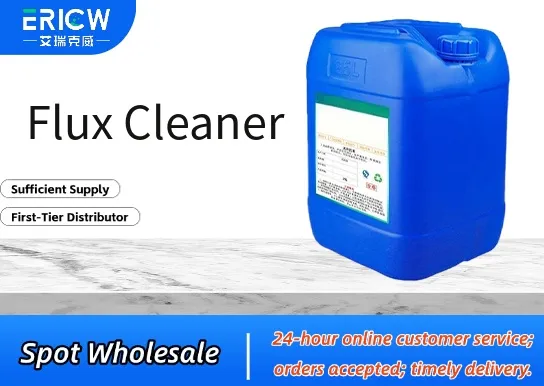
Non-chlorinated, low-VOC formulation for safer handling and reduced environmental impact.
Rapid residue removal without aggressive solvents—preserves sensitive solder mask and conformal coatings.
Residue-free evaporation leaves no ionic or non-volatile residues (tested per IPC-J-STD-001 & IPC-TM-650 2.3.25).
pH-neutral chemistry ensures compatibility with aluminum, copper, and plated through-holes.
Ready-to-use liquid—no dilution or mixing required for manual, spray, or ultrasonic cleaning.
Post-reflow cleaning of leaded and lead-free solder pastes in electronics assembly.
Removal of rosin-based, no-clean, and water-soluble flux residues from PCBAs.
Cleaning of fine-pitch components (e.g., 01005, QFN, BGA) prior to inspection or conformal coating.
Pre-encapsulation cleaning to prevent delamination and adhesion failure in potting processes.
Maintenance cleaning of stencil printers, pick-and-place nozzles, and reflow oven conveyors.
| Chemical Type | Hydrocarbon blend with polar aprotic co-solvents |
| Product Form | Clear, colorless liquid |
| Appearance | Transparent, free of suspended particles or haze |
| Odor | Mild, non-irritating hydrocarbon odor |
| Primary Applications | Flux residue removal from printed circuit boards and electronic assemblies |
| Key Features | Non-ozone-depleting, non-corrosive, non-flammable (flash point > 60°C) |
| Benefits | Reduces post-process defects; supports IPC-A-610 Class 2 & 3 compliance |
| Regulatory Compliance | REACH SVHC-free, RoHS 2015/863 compliant, TSCA-listed |
| Common Compatible Systems | Suitability |
| Ultrasonic cleaning systems (40–80 kHz) | Highly Recommended – Optimized cavitation efficiency with no foaming or emulsification |
| Batch spray-in-air cleaners (e.g., Aqueous Technologies, Electrolube) | Recommended – Compatible with stainless steel tanks and polypropylene nozzles |
| Manual brush cleaning stations with lint-free wipes | Suitable – Low surface tension enables capillary penetration into tight gaps |
| Vapor degreasing equipment (modified alcohol-based) | Suitable – Non-reactive with stainless steel condensers; requires solvent recovery verification |
Q1: What is the CAS Registry Number for Flux Cleaner?
A: The product is a proprietary multi-component blend; individual constituents are listed under CAS numbers 108-88-3 (p-xylene), 1333-82-0 (isoparaffinic hydrocarbons), and 8002-44-2 (petroleum distillates). Full composition is disclosed in the SDS upon request.
Q2: What is the recommended usage concentration and dwell time?
A: Use as supplied (100% concentration). For manual cleaning: 15–30 seconds contact time. For ultrasonic immersion: 2–5 minutes at 40–50°C. No rinsing required for standard applications.
Q3: How does Flux Cleaner compare to IPA or acetone for flux removal?
A: Unlike IPA (poor solvency for rosin) or acetone (aggressive on plastics, high volatility), Flux Cleaner offers balanced polarity, lower evaporation rate, and superior residue dissolution without substrate attack or static charge generation.
Q4: Is Flux Cleaner certified for aerospace or medical device manufacturing?
A: Yes—it meets NASA-STD-6016 requirements for ionic cleanliness and is qualified per GE Aerospace P25-00003 and Medtronic MDS-0001 for Class IIa device cleaning validation (full test report available under NDA).
Q5: Does Flux Cleaner leave extractable residues that could migrate under bias conditions?
A: No—validated per IPC-TM-650 2.6.25B (Surface Insulation Resistance after bias/humidity testing). Ionic contamination < 0.2 µg/cm² NaCl-equivalent; no measurable halide or amine migration observed at 85°C/85% RH for 168 hrs.
Contact With Us:
E-mail: wangxingqiang@ericwchem.com
Have a Questions? Call Us:
Add:
Building A1, Jiete Industrial Park, Huangpu District, Guangzhou City, Guangdong Province, China