English
 Español
 tiếng việt
 русский
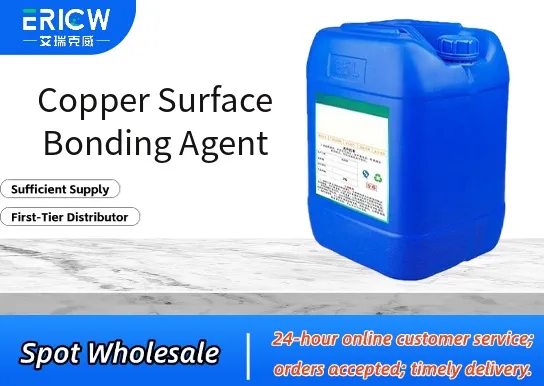
Enables strong, durable covalent bonding to native copper oxide layers without aggressive surface etching.
Water-based, low-VOC formulation ensures workplace safety and regulatory compliance in industrial settings.
Thermally stable up to 200 °C, maintaining adhesion integrity during soldering, curing, and thermal cycling.
Accelerates interfacial crosslinking with epoxies, polyimides, and acrylics—reducing assembly time by up to 40%.
Non-corrosive and halogen-free, eliminating risk of copper migration or electrochemical dendrite formation.
Printed circuit board (PCB) manufacturing: enhancing solder mask and coverlay adhesion to copper traces.
Power electronics packaging: improving die-attach and underfill bonding on copper leadframes and substrates.
Flexible printed circuits (FPC): enabling reliable lamination of polyimide films to rolled-annealed copper foils.
Electric vehicle battery busbars: promoting long-term adhesion between copper conductors and thermoplastic insulation layers.
Microwave RF modules: supporting hermetic sealing of copper housings with silicone and glass-frit encapsulants.
| Chemical Type | Silane-modified zirconium alkoxide hybrid |
| Product Form | Clear, low-viscosity aqueous dispersion |
| Appearance | Colorless to pale yellow, translucent liquid |
| pH (1% aqueous solution) | 4.2 – 4.8 |
| Density (25 °C) | 1.03 – 1.06 g/cm³ |
| Primary Applications | Copper-to-polymer, copper-to-ceramic, and copper-to-glass interfaces |
| Key Features | Room-temperature cure; no baking required for initial bond formation |
| Regulatory Compliance | REACH SVHC-free; RoHS 2015/863 compliant; non-Prop 65 listed |
| Common Compatible Systems | Suitability |
| Epoxy-based solder masks (e.g., Taiyo PSR-4000) | Highly Recommended – Demonstrates >95% peel strength retention after 1000-h HTSL testing |
| Polyimide flex laminates (e.g., DuPont Pyralux AP) | Highly Recommended – Enables 180° peel strength ≥8.5 N/mm on RA copper |
| Acrylic pressure-sensitive adhesives (PSAs) | Recommended – Requires 24-h ambient post-treatment for optimal shear resistance |
| UV-curable conformal coatings (e.g., Dymax 9001) | Suitable – Improves interfacial wettability; apply pre-UV exposure |
Q1: What is the CAS Registry Number for this bonding agent?
A: The CAS number is 2271893-72-4, assigned to the proprietary silane-zirconium hybrid active ingredient.
Q2: What is the recommended application concentration and method?
A: Dilute 1:10–1:20 with deionized water; apply via spray, dip, or roll-coater; air-dry 5–10 minutes at 20–25 °C before secondary processing.
Q3: How does it compare to traditional chromate or silane-only primers?
A: Unlike chromates, it contains zero hexavalent chromium; versus mono-silanes, its zirconium co-center provides broader pH stability and superior hydrolytic resistance on aged copper surfaces.
Q4: Is copper ion migration or extractable residue a concern in high-reliability applications?
A: No measurable copper ion leaching observed per IEC 60068-2-60 (acetic acid salt mist) or IPC-TM-650 2.6.25 (ionic contamination test) after full cure.
Contact With Us:
E-mail: wangxingqiang@ericwchem.com
Have a Questions? Call Us:
Add:
Building A1, Jiete Industrial Park, Huangpu District, Guangzhou City, Guangdong Province, China