English
 Español
 tiếng việt
 русский
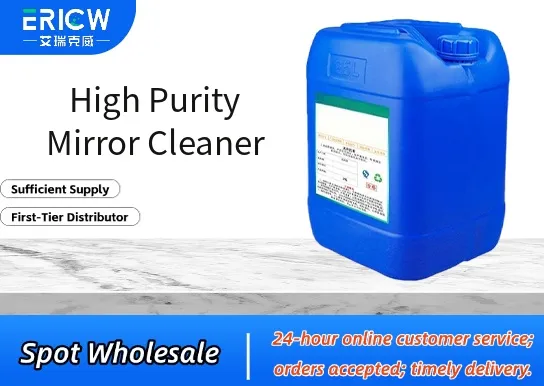
Ultra-low non-volatile residue (NVR) — < 10 ppm after evaporation, ensuring optical clarity and zero haze on precision surfaces.
Zero halogen and sulfur content — fully compliant with semiconductor-grade cleanliness standards for sensitive optics and metrology equipment.
Controlled volatility profile — rapid drying without streaking or static charge buildup on coated mirrors and laser optics.
Non-corrosive to aluminum, dielectric coatings, fused silica, and calcium fluoride substrates.
Manufactured and packaged under ISO Class 5 cleanroom conditions with double-bagged HDPE containers.
Cleaning of high-reflectivity laser cavity mirrors in excimer and ultrafast laser systems.
Final rinse and wipe-down of EUV lithography optics and beamline components.
Pre-calibration cleaning of interferometric reference mirrors and metrology-grade flatness standards.
Maintenance of astronomical telescope secondary mirrors and adaptive optics deformable mirrors.
Decontamination of optical windows and lenses in vacuum UV (VUV) spectroscopy instrumentation.
| Chemical Type | High-purity azeotropic blend of hydrofluoroether (HFE-7100) and low-boiling ester (ethyl lactate) |
| Product Form | Clear, colorless liquid |
| Appearance | Transparent, particle-free, no phase separation |
| Boiling Range | 55–78 °C (at 760 mmHg) |
| Primary Applications | Residue-free cleaning of precision optical surfaces, laser optics, and coated mirrors |
| Key Features | Non-ozone depleting, non-flammable (flash point > 60 °C), static-dissipative |
| Benefits | No post-cleaning baking required; compatible with automated spray-clean and vapor-degrease systems |
| Regulatory Compliance | REACH SVHC-free, RoHS 3 compliant, California Prop 65 listed as “not known to cause cancer or reproductive toxicity” |
| Common Compatible Systems | Suitability |
| Automated Precision Wipe Systems (e.g., MRC CleanWipe™) | Highly Recommended – Optimized solvent delivery kinetics and residue control |
| Vapor Degreasing Equipment (e.g., Techspray VaporClean®) | Recommended – Requires condenser temperature adjustment to 45–50 °C for full recovery |
| Ultrasonic Cleaning Baths (25–40 kHz) | Suitable – Use only with stainless-steel tanks and dedicated low-frequency mode; avoid aluminum fixtures |
| Manual Clean Stations with PTFE-Tipped Dispensers | Highly Recommended – Minimal aerosol generation and consistent metered dosing |
Q1: What is the CAS Registry Number for High Purity Mirror Cleaner?
A: This is a proprietary multi-component formulation; individual CAS numbers are assigned to constituents: HFE-7100 (CAS 13213-22-2), ethyl lactate (CAS 97-64-3). Full composition disclosure requires signed CDA.
Q2: What is the recommended usage concentration and method for manual cleaning?
A: Use undiluted. Apply via lint-free polyester swab or Class 10 cleanroom wipe saturated but not dripping. Wipe in straight-line motion with light pressure; allow 15–30 seconds for complete evaporation before inspection.
Q3: How does it compare to isopropyl alcohol (IPA) for mirror cleaning?
A: Unlike IPA, this cleaner leaves no hygroscopic residue, exhibits lower surface tension for improved capillary action into micro-roughness, and eliminates static-related particulate attraction — critical for sub-10 nm RMS surface finishes.
Q4: Are there any known extractables or leachables when used with fluoropolymer tubing (e.g., PFA, FEP)?
A: No measurable extractables observed per USP <87> cytotoxicity testing or GC-MS analysis after 72-hour contact at 25 °C; certified compatible for use with PFA, FEP, and ETFE fluid paths.
Contact With Us:
E-mail: wangxingqiang@ericwchem.com
Have a Questions? Call Us:
Add:
Building A1, Jiete Industrial Park, Huangpu District, Guangzhou City, Guangdong Province, China