English
 Español
 tiếng việt
 русский
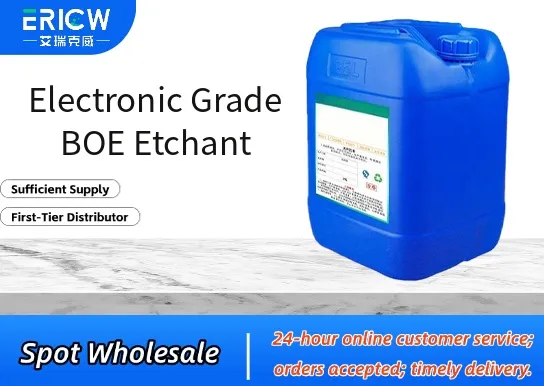
Ultra-low metallic impurity levels (≤10 ppt for Na, K, Fe, Cu, Ni, Cr, Zn, Al), meeting SEMI C12 and ASTM F2298 standards.
Controlled etch rate uniformity (<±3% across 300 mm wafers) enabled by precise HF–NH₄F molar ratio and rigorous batch-to-batch consistency.
Stabilized formulation with proprietary chelating agents to suppress particle generation and minimize post-etch residue.
Low volatility and reduced fuming characteristics versus traditional HF-based etchants, enhancing workplace safety and process control.
Ready-to-use liquid format with strict particulate control (<20 particles/mL @ ≥0.2 µm per ISO 14644-1 Class 5).
Isotropic silicon dioxide (SiO₂) etching in MEMS fabrication, including cavity release and structural layer definition.
Gate oxide removal and spacer etch in advanced CMOS and FinFET front-end-of-line (FEOL) processes.
Photoresist stripping and post-ash residue cleaning prior to metallization in 3D NAND and DRAM manufacturing.
Surface conditioning of quartz and fused silica substrates for photomask and EUV reticle cleaning.
Controlled undercutting in STI (shallow trench isolation) and LOCOS (local oxidation of silicon) processing.
| Chemical Type | Buffered Oxide Etchant (HF/NH₄F aqueous solution) |
| Product Form | Clear, colorless liquid |
| Appearance | Homogeneous, particle-free, no sediment or haze |
| Primary Applications | Etching of thermal & PECVD SiO₂, BPSG, PSG, and TEOS films |
| Key Features | Buffered pH (~4.5–5.2), low HF activity, high selectivity (>100:1 vs. Si, >50:1 vs. Si₃N₄) |
| Benefits | Reduced wafer stress, minimal surface roughening, compatibility with aluminum and titanium nitride masks |
| Regulatory Compliance | REACH SVHC free, RoHS 3 compliant, non-RCRA hazardous per EPA 40 CFR 261 |
| Packaging | High-purity fluoropolymer-lined HDPE or FEP bottles (1 L, 4 L, 20 L, 200 L) |
| Common Compatible Systems | Suitability |
| SEMI-standard wet bench (e.g., Modutek, Entegris, Tokyo Electron CleanTrack) | Highly Recommended – Fully validated for temperature-controlled immersion, spray, and megasonic delivery |
| Single-wafer spin-rinse-dry (SRD) platforms (e.g., Lam Research SOLA, SCREEN Swift) | Recommended – Requires optimized dispense flow and dwell time; validated for ≤300 mm wafers |
| Automated chemical dispensing systems with fluoropolymer fluid paths | Highly Recommended – Compatible with PFA, ETFE, and FEP tubing, diaphragm pumps, and level sensors |
| Quartz or PFA-lined recirculating bath systems | Suitable – Requires continuous filtration (0.1 µm PTFE) and real-time HF concentration monitoring |
Q1: What is the CAS Number for Electronic Grade BOE Etchant?
A: BOE is a formulated mixture and does not have a single CAS number. Individual components are: Hydrofluoric acid (7664-39-3), Ammonium fluoride (12125-01-8). Full formulation is documented under proprietary product code EG-BOE-999.
Q2: What is the recommended usage concentration and temperature range?
A: Supplied as ready-to-use solution. Optimal etch performance is achieved at 20–25 °C. No dilution required. Elevated temperatures (>30 °C) accelerate etch rate but reduce selectivity and increase particle risk.
Q3: How does this Electronic Grade BOE differ from industrial-grade BOE?
A: Electronic Grade BOE undergoes additional sub-ppq metal purification (ICP-MS verified), Class 10 cleanroom bottling, and strict anion/organic impurity controls (Cl⁻ < 50 ppt, TOC < 10 ppb), which industrial grades do not meet.
Q4: Does it comply with semiconductor industry migration testing requirements (e.g., SEMI F57)?
A: Yes. Validated per SEMI F57 for extractables/leachables: total ionic contamination < 5 ng/cm² after 60-min soak on bare Si wafers at 25 °C, with no detectable fluorosilicates or ammonium residues by IC/ICP-MS.
Q5: Is it compatible with photoresist and hardmask materials used in advanced nodes?
A: Demonstrated compatibility with ArF-immersion resists (e.g., JSR ARES series), SiARC, and TiN/Ti hardmasks at standard process times. Prolonged exposure (>120 s) may cause resist swelling; endpoint monitoring is advised.
Contact With Us:
E-mail: wangxingqiang@ericwchem.com
Have a Questions? Call Us:
Add:
Building A1, Jiete Industrial Park, Huangpu District, Guangzhou City, Guangdong Province, China