English
 Español
 tiếng việt
 русский
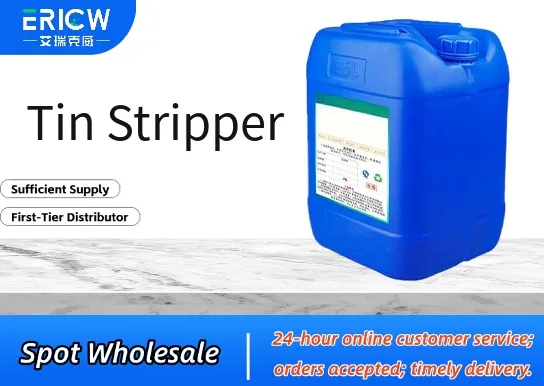
Non-cyanide, environmentally responsible formulation compliant with modern RoHS and REACH requirements.
Controlled etch rate ensures uniform tin removal without undercutting or base metal attack on copper, brass, or steel substrates.
Low-foaming and stable in recirculating bath systems, minimizing drag-out and extending bath life.
pH-buffered chemistry maintains consistent performance across temperature fluctuations (20–50 °C).
Compatible with automated spray and immersion stripping lines; requires no post-strip neutralization rinse for most applications.
Removal of solderable tin and tin-lead plating from printed circuit board (PCB) edge connectors prior to rework or recycling.
Stripping of decorative tin coatings from automotive fasteners and electrical contact components.
Preparation of tin-plated copper busbars for recoating or surface analysis in power distribution systems.
Recovery of high-purity copper substrates during electronics component refurbishment.
De-tinning of obsolete or surplus electronic assemblies prior to precious metal recovery.
| Chemical Type | Aqueous acidic oxidizer blend (organic acid-based, non-hydrochloric) |
| Product Form | Concentrated liquid (ready-to-dilute) |
| Appearance | Clear, pale amber solution |
| Specific Gravity (25 °C) | 1.08–1.12 g/cm³ |
| pH (as supplied) | 1.2–1.8 |
| Primary Applications | Tin and tin-alloy stripping from Cu, Cu alloys, Fe, and Ni substrates |
| Key Features | No cyanide, no chromates, low volatility, biodegradable chelators |
| Regulatory Compliance | REACH SVHC-free, RoHS 2015/863 compliant, OSHA HazCom aligned SDS available |
| Common Compatible Systems | Suitability |
| Immersion tank systems (static or air-agitated) | Highly Recommended – Optimal at 40–45 °C with 1–5 min dwell time |
| Spray-in-air conveyor lines | Recommended – Requires 50–60 °C nozzle temperature and 30–90 sec exposure |
| Ultrasonic cleaning tanks (40 kHz) | Suitable – Effective for complex geometries; reduce concentration by 20% to minimize cavitation erosion |
| Recirculating filtration systems with carbon/polish media | Highly Recommended – Extends bath life >8x vs. non-filtered operation |
Q1: What is the CAS Registry Number for Tin Stripper?
A: This product is a proprietary multi-component formulation; individual CAS numbers are not assigned to the concentrate. Full ingredient disclosure per TSCA and EU Annex VI is provided in Section 3 of the Safety Data Sheet (SDS).
Q2: What is the recommended working concentration and typical strip rate?
A: Dilute 1:4 to 1:9 (v/v) with deionized water. At 45 °C, strip rate averages 0.8–1.2 µm/min on 5–10 µm electroplated tin layers over copper.
Q3: How does Tin Stripper compare to nitric- or ferric chloride-based strippers?
A: Unlike aggressive mineral-acid strippers, Tin Stripper eliminates NOₓ fumes, reduces corrosion risk to equipment, and enables safer handling without fume hoods in well-ventilated areas. It also minimizes intermetallic residue formation on copper substrates.
Q4: Is Tin Stripper suitable for use in medical device reprocessing where extractables must be minimized?
A: Yes — validated per USP <788> and ISO 10993-12 for low particulate and low ionic extractables when rinsed with ≥2× deionized water post-strip. Certificate of Analysis includes residual organic acid testing.
Q5: Does Tin Stripper require special waste treatment before discharge?
A: Yes — spent bath contains dissolved tin (Sn²⁺/Sn⁴⁺) and requires precipitation (e.g., with lime or sodium hydroxide) followed by filtration. Neutralized sludge is typically non-hazardous per TCLP testing; consult local regulations and perform site-specific verification.
Contact With Us:
E-mail: wangxingqiang@ericwchem.com
Have a Questions? Call Us:
Add:
Building A1, Jiete Industrial Park, Huangpu District, Guangzhou City, Guangdong Province, China