English
 Español
 tiếng việt
 русский
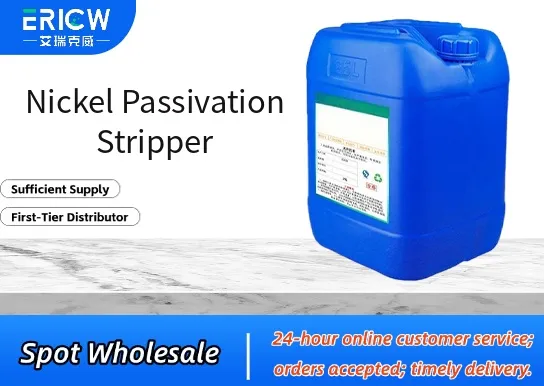
Non-cyanide, environmentally responsible formulation compliant with modern industrial hygiene standards.
Controlled stripping kinetics—removes nickel passivation layers without attacking underlying stainless steel or nickel alloys.
Low foaming and stable in recirculating bath systems at 40–60 °C.
pH-buffered to maintain consistent activity across extended bath life (typically >100 hr operational stability).
Readily biodegradable components minimize wastewater treatment burden.
Pre-treatment for re-passivation of stainless steel components in pharmaceutical manufacturing equipment.
Removal of aged or contaminated nickel-based passive films from aerospace fasteners and fittings.
Surface preparation prior to electroplating or thermal spray coating on nickel-alloy substrates.
Maintenance cleaning of heat exchangers and piping systems in chemical processing plants.
Restoration of corrosion resistance on welded joints after fabrication-induced chromium depletion.
| Chemical Type | Acidic chelating blend (organic acid + complexing agents) |
| Product Form | Concentrated liquid (ready-to-dilute) |
| Appearance | Clear, pale amber liquid |
| pH (as supplied) | 2.1–2.5 (25 °C) |
| Density (25 °C) | 1.08–1.12 g/cm³ |
| Primary Applications | Stripping of nickel-rich passive oxides from stainless steels and Ni-based alloys |
| Key Features | Non-oxidizing, non-fuming, low metal ion carryover |
| Regulatory Compliance | REACH registered; SDS available per ISO 45001 & GHS Rev. 8 |
| Common Compatible Systems | Suitability |
| Stainless Steel (304, 316, 316L) | Highly Recommended – Minimal base metal attack; optimal film removal rate |
| Inconel® 600 / 625 | Recommended – Effective with extended dwell time; verify post-strip corrosion resistance |
| Monel® 400 | Suitable – Requires temperature control (<55 °C) and post-rinse neutralization |
| Aqueous ultrasonic cleaning systems | Highly Recommended – Fully compatible with standard 40 kHz transducers and stainless tanks |
Q1: What is the CAS Registry Number for Nickel Passivation Stripper?
A: This is a proprietary multi-component formulation; individual CAS numbers are assigned only to key ingredients (e.g., citric acid: 77-92-9; gluconic acid: 526-95-4). Full composition is disclosed under NDA and listed on the Safety Data Sheet (SDS Section 3).
Q2: What is the recommended working concentration and immersion time?
A: Dilute 1:9 with deionized water (10% v/v) for manual or immersion use; typical dwell time is 5–15 minutes at 45–55 °C. For automated spray systems, use 5–8% concentration with 90–180 seconds contact time.
Q3: How does this product compare to nitric/hydrofluoric acid-based strippers?
A: Unlike HF/Nitric blends, this stripper eliminates toxic fumes, severe skin hazards, and regulatory reporting burdens. It achieves comparable oxide removal efficacy on austenitic stainless steels while preserving surface finish and dimensional integrity.
Q4: Does it meet FDA or USP requirements for pharmaceutical contact surfaces?
A: While not an FDA-approved substance, it complies with FDA 21 CFR §178.3620 (indirect food additives) for cleaning agents used on equipment contacting food/pharmaceutical products. Residue validation protocols (e.g., TOC ≤ 1 ppm) are supported per client SOPs.
Q5: Is there risk of nickel migration or leaching into treated parts during storage?
A: No—this stripper does not introduce nickel ions; it removes existing surface oxides. Post-treatment rinse (deionized water, pH 6.5–7.5) and immediate drying prevent re-oxidation or residual chelate entrapment. Accelerated extraction testing (ASTM D1388) shows <0.02 ppm Ni release after 72-hr distilled water soak.
Contact With Us:
E-mail: wangxingqiang@ericwchem.com
Have a Questions? Call Us:
Add:
Building A1, Jiete Industrial Park, Huangpu District, Guangzhou City, Guangdong Province, China