English
 Español
 tiếng việt
 русский
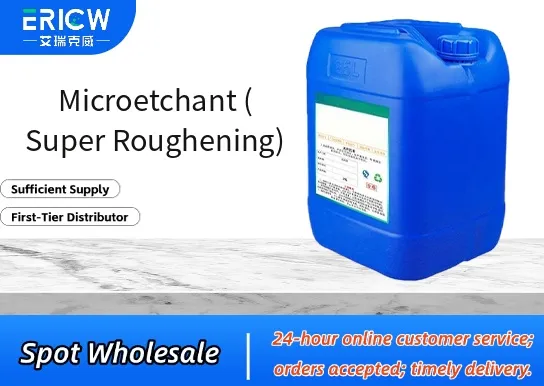
Engineered for ultra-fine, uniform micro-roughening of copper and copper alloy surfaces to enhance adhesive bonding strength.
Non-cyanide, low-corrosivity formulation ensures improved workplace safety and reduced wastewater treatment burden.
Consistent etch rate control across wide operating temperature and concentration ranges (20–45 °C, 3–8 vol%).
Minimal sludge generation and excellent bath stability over extended operational life (>12 weeks under typical replenishment).
Compatible with automated spray and immersion systems; supports high-throughput PCB and flex circuit manufacturing.
Pre-treatment for copper foil lamination in high-reliability rigid and HDI printed circuit boards (PCBs).
Surface activation prior to solder mask or coverlay application in flexible printed circuits (FPCs).
Enhancing bond integrity between copper layers and dielectric substrates in embedded passive devices.
Roughening inner-layer copper before sequential build-up (SBU) in advanced packaging substrates.
Micro-roughening of copper-clad laminates for aerospace-grade thermal management assemblies.
| Chemical Type | Acidic non-oxidizing microetchant based on organic acid complex and catalytic accelerator |
| Product Form | Concentrated liquid (ready-to-dilute aqueous solution) |
| Appearance | Clear, pale amber liquid, free of suspended solids |
| pH (1% w/w aqueous solution at 25 °C) | 2.1–2.5 |
| Primary Applications | Copper surface micro-roughening for adhesion promotion in PCB, FPC, and substrate manufacturing |
| Key Features | Non-cyanide, low metal ion leaching, controlled anisotropic etching profile |
| Benefits | Improved peel strength (>9.0 N/mm), reduced micro-void formation, compatibility with lead-free assembly processes |
| Regulatory Compliance | REACH SVHC-free, RoHS 2015/863 compliant, no listed Prop 65 carcinogens |
| Common Compatible Systems | Suitability |
| Vertical Spray Etching Lines (e.g., Atotech VERSA, MacDermid Enthone VERTICUT) | Highly Recommended – Optimized for nozzle pressure, dwell time, and rinse efficiency |
| Batch Immersion Tanks with Air Agitation | Recommended – Requires precise temperature control (±1 °C) and filtration (5 µm) |
| Inline Conveyorized Systems with Counter-Current Rinsing | Suitable – Validated for >20 m/min line speed and ≤30 s exposure time |
| Recirculating Filtration Loops with Carbon Adsorption | Recommended – Extends bath life and maintains consistent etch rate |
Q1: What is the CAS Registry Number for Microetchant (Super Roughening)?
A: The product is a proprietary multi-component formulation; individual CAS numbers are assigned to key constituents only—full disclosure requires signed CDA. Typical major components include CAS 64-19-7 (acetic acid) and CAS 142-84-7 (glycolic acid).
Q2: What is the recommended working concentration and typical consumption rate?
A: Standard dilution is 4–6 vol% in deionized water. Consumption averages 0.8–1.2 L per square meter of processed copper surface, depending on etch depth target (0.2–0.5 µm) and line speed.
Q3: How does Microetchant (Super Roughening) differ from traditional persulfate or cupric chloride etchants?
A: Unlike aggressive oxidizers, it delivers isotropic micro-roughening without undercutting or excessive copper dissolution. It avoids sulfate accumulation, eliminates NOx fumes, and enables tighter process control for fine-line (<50 µm) features.
Q4: Is migration or extractable residue testing data available for high-reliability electronics applications?
A: Yes—per IPC-TM-650 2.6.25, residual ionic contamination is <0.7 µg/cm² NaCl equivalent after standard DI rinse and dry. Full IEC 61249-2-21 compliant test reports available under NDA.
Q5: Does this product meet UL recognition requirements for printed wiring board materials?
A: Yes—formulation is recognized under UL File E492209 for use in UL 796-listed PCB laminates when applied per approved process parameters and validated post-etch cleanliness protocols.
Contact With Us:
E-mail: wangxingqiang@ericwchem.com
Have a Questions? Call Us:
Add:
Building A1, Jiete Industrial Park, Huangpu District, Guangzhou City, Guangdong Province, China