English
 Español
 tiếng việt
 русский
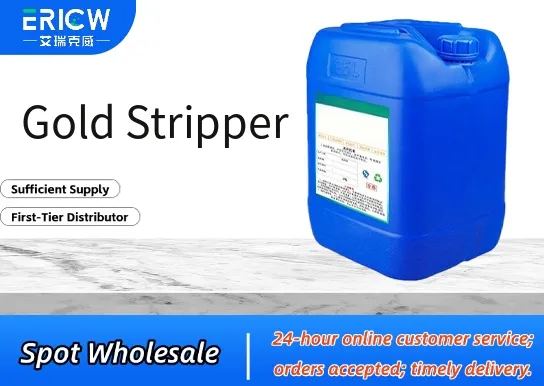
Highly selective removal of gold plating without attacking underlying nickel, copper, or stainless steel substrates.
Non-cyanide, low-toxicity formulation compliant with modern environmental and occupational safety standards.
Room-temperature operation eliminates energy-intensive heating requirements and reduces process variability.
Rapid stripping kinetics—achieves complete gold removal in 30–120 seconds under standard immersion conditions.
Stable bath life with minimal drag-out loss; compatible with standard filtration and carbon treatment for extended reuse.
Recovery and refurbishment of gold-plated electronic connectors, edge fingers, and PCB contact pads.
Stripping of gold from aerospace-grade beryllium copper spring contacts prior to re-plating.
Preparation of precious metal-bearing scrap (e.g., spent catalysts, EOL semiconductor packages) for hydrometallurgical recovery.
Quality assurance testing—controlled removal of gold layers to verify plating thickness and adhesion integrity.
Repair and rework of high-reliability medical device components requiring trace-metal-clean surfaces.
| Chemical Type | Aqueous iodine/iodide-based oxidative system |
| Product Form | Liquid concentrate (ready-to-dilute) |
| Appearance | Clear amber solution, slight characteristic odor |
| Density (25°C) | 1.12–1.16 g/cm³ |
| pH (10% v/v aqueous dilution) | 7.8–8.4 |
| Primary Applications | Selective gold stripping from non-ferrous and noble metal substrates |
| Key Features | Non-volatile, non-flammable, no NOx or HCN evolution |
| Regulatory Compliance | REACH SVHC-free, RoHS-compliant, OSHA HCS-aligned SDS available |
| Common Compatible Systems | Suitability |
| Standard immersion tanks (PP, PVC, or CPVC-lined) | Highly Recommended – Chemically resistant and thermally stable up to 40°C |
| Automated spray rinse lines with recirculation | Recommended – Requires inline filtration (5 µm) and pH monitoring |
| Ultrasonic-assisted stripping systems (40 kHz) | Suitable – Enhances uniformity on complex geometries; avoid prolonged exposure >5 min |
| Carbon-bed purification units (activated charcoal) | Highly Recommended – Effectively removes dissolved gold complexes and organic byproducts |
Q1: What is the CAS Registry Number for Gold Stripper?
A: Gold Stripper is a proprietary multi-component formulation; individual ingredients are listed under CAS numbers 7553-56-2 (I₂), 14932-42-6 (KI), and 7789-20-0 (KIO₃). The final product does not carry a single CAS number per IUPAC and EPA guidelines.
Q2: What is the recommended working concentration and immersion time?
A: Dilute 1 part concentrate with 4–9 parts deionized water (10–20% v/v). Typical immersion time ranges from 30 seconds (thin flash gold, ≤0.1 µm) to 120 seconds (heavy build-up, ≥1.0 µm) at 20–25°C.
Q3: How does Gold Stripper compare to cyanide-based strippers in terms of gold recovery efficiency?
A: Gold Stripper achieves >99.2% gold dissolution efficiency comparable to cyanide systems, but forms stable [AuI₂]⁻ complexes that enable direct electrowinning or sodium metabisulfite precipitation—eliminating hazardous CN⁻ handling and complex wastewater neutralization.
Q4: Is Gold Stripper approved for use in ISO 13485-certified medical device manufacturing?
A: Yes—validated for residue-free stripping per ISO 10993-12 protocols; final rinse conductivity ≤1.2 µS/cm and total organic carbon (TOC) < 50 ppb meet Class III device cleaning requirements.
Q5: Can Gold Stripper be used to extract gold from ceramic-based MLCCs or silicon wafers?
A: It is effective for surface gold on ceramic substrates (e.g., termination metallization), but not recommended for silicon wafers due to potential iodide-induced surface oxidation; use only after rigorous compatibility testing on dielectric passivation layers.
Contact With Us:
E-mail: wangxingqiang@ericwchem.com
Have a Questions? Call Us:
Add:
Building A1, Jiete Industrial Park, Huangpu District, Guangzhou City, Guangdong Province, China