English
 Español
 tiếng việt
 русский
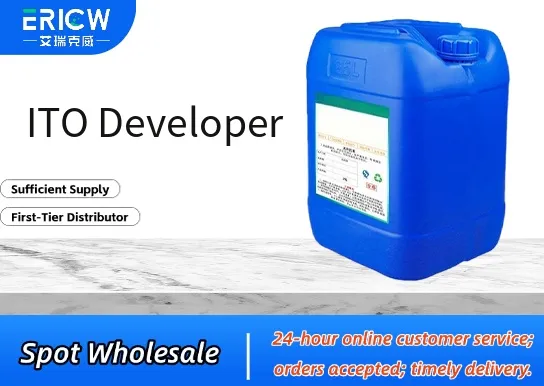
Highly selective etching of indium tin oxide (ITO) thin films without significant undercut or damage to underlying substrates.
Stable aqueous formulation with consistent performance across extended bath life and multiple process cycles.
Low metal ion contamination profile, meeting stringent requirements for display and touch sensor manufacturing.
pH-controlled chemistry enabling precise process window management and compatibility with automated wet benches.
Non-hazardous classification under GHS for transport and workplace handling (non-corrosive, non-oxidizing).
Photolithographic patterning of ITO electrodes in flat-panel displays (LCD, OLED).
Touch panel sensor fabrication for consumer electronics and automotive HMIs.
Transparent conductive film processing in flexible electronics and smart windows.
R&D-scale ITO etching in university and industrial thin-film laboratories.
Repair and rework of defective ITO layers during pilot-line fabrication.
| Chemical Type | Aqueous alkaline etchant blend |
| Product Form | Liquid concentrate (ready-to-dilute) |
| Appearance | Clear, colorless to pale yellow solution |
| Primary Applications | Wet etching of sputtered or evaporated ITO films (100–500 nm thickness) |
| Key Features | Controlled etch rate (8–12 Å/sec at 30°C), minimal residue formation |
| Benefits | Reduced particle generation, improved yield in high-resolution patterning |
| Regulatory Compliance | REACH SVHC-free; RoHS 2015/863 compliant; no listed PFAS substances |
| Storage Stability | ≥24 months unopened at 15–25°C |
| Common Compatible Systems | Suitability |
| SEMITOOL E-Series Wet Processing Tools | Highly Recommended – Optimized for spray/rinse cycle integration and temperature control |
| Modutek Teflon®-lined Batch Tanks | Recommended – Compatible with PFA, PVDF, and quartz wet benches |
| Kyoto Micro Devices KMD-2000 Series | Suitable – Requires standard filtration (0.2 µm) and recirculation calibration |
| Manual Dip Stations (Class 100 Cleanroom) | Recommended – Validated for single-wafer and small-substrate processing |
Q1: What is the CAS Registry Number for ITO Developer?
A: This product is a proprietary multi-component formulation; individual CAS numbers are not assigned. Full ingredient disclosure is available under NDA upon request for qualified customers.
Q2: What is the recommended working concentration and typical etch rate?
A: Dilute 1:9 with deionized water (10% v/v). Typical etch rate is 10 ± 2 Å/sec on 200-nm ITO at 30°C with gentle agitation.
Q3: How does ITO Developer compare to traditional HCl/HNO₃-based etchants?
A: It eliminates hazardous fumes, reduces substrate corrosion risk (especially on PET and PI), and enables higher resolution (<5 µm line/space) without aggressive post-etch cleaning.
Q4: Is ITO Developer compliant with ISO 14644-1 Class 5 cleanroom standards for particle generation?
A: Yes — validated per JIS B 9921:2010 methodology; ≤5 particles ≥0.3 µm per mL after 0.1 µm filtration.
Q5: Are there any known migration or extractables concerns when used on medical-grade flexible substrates?
A: Extractables testing per USP <788> and ISO 10993-12 confirms no leachable organics or metals above AET thresholds under standard process conditions.
Contact With Us:
E-mail: wangxingqiang@ericwchem.com
Have a Questions? Call Us:
Add:
Building A1, Jiete Industrial Park, Huangpu District, Guangzhou City, Guangdong Province, China