English
 Español
 tiếng việt
 русский
High hydroxyl functionality for excellent crosslinking density with melamine and polyisocyanate curing agents.
Low VOC formulation compliant with stringent environmental regulations for industrial coatings.
Superior weather resistance and UV stability for long-term gloss and color retention.
Excellent compatibility with common solvent-based resins and pigments in multi-component systems.
Balanced molecular weight distribution ensuring good flow, leveling, and film formation.
Automotive OEM topcoats and clearcoats.
Industrial maintenance coatings for metal substrates.
General-purpose coil coatings requiring durability and flexibility.
High-performance appliance finishes.
Prefinished wood and MDF coatings for furniture and cabinetry.
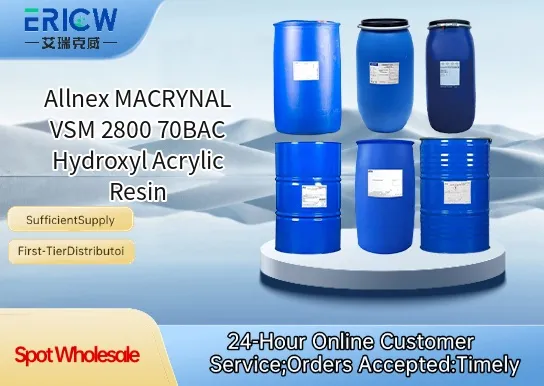
| Chemical Type | Hydroxyl-functional acrylic copolymer |
| Product Form | Liquid resin solution |
| Appearance | Clear to slightly hazy, colorless to pale yellow liquid |
| Solvent System | Butyl acetate / xylene blend |
| Hydroxyl Value (mg KOH/g) | 70–75 |
| Acid Value (mg KOH/g) | < 5 |
| Non-Volatile Content (% w/w) | 68–72 |
| Viscosity (DIN 4mm, 23°C, mPa·s) | 100–160 |
Q1: What is the primary function of MACRYNAL VSM 2800 70BAC in coating formulations?
A: It serves as a hydroxyl-functional acrylic resin designed to act as a reactive binder in two-component polyurethane and melamine-cured systems, contributing to film formation, hardness development, and chemical resistance.
Q2: Is this resin compatible with high-solids or low-VOC formulations?
A: Yes — its medium molecular weight and balanced polarity support formulation flexibility, making it suitable for high-solids coatings and VOC-reduced systems when combined with appropriate solvents and crosslinkers.
Q3: How does VSM 2800 70BAC perform in terms of weathering and UV stability?
A: As a non-yellowing acrylic resin with inherent UV resistance, it delivers excellent long-term gloss retention and color stability in exterior applications, particularly when used in topcoats requiring durable aesthetic performance.
Q4: Can this resin be used in automotive refinish or industrial maintenance coatings?
A: Yes — it is widely employed in demanding OEM-adjacent and refinish applications where fast cure response, substrate adhesion, and mechanical robustness are required, including metal and plastic substrates.
Contact With Us:
E-mail: wangxingqiang@ericwchem.com
Have a Questions? Call Us:
Add:
Building A1, Jiete Industrial Park, Huangpu District, Guangzhou City, Guangdong Province, China