English
 Español
 tiếng việt
 русский
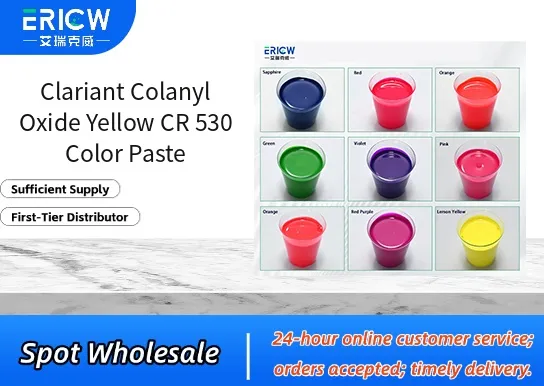
High chroma yellow shade with excellent lightfastness and thermal stability for demanding processing conditions.
Optimized rheology for easy dispersion in water-based and solvent-based systems without excessive shear.
Low volatile organic compound (VOC) content, supporting compliance with modern environmental and regulatory standards.
Consistent batch-to-batch color performance ensured by Clariant’s stringent quality control and traceable manufacturing.
Compatible with common polymer matrices including PVC, ABS, and polyolefins for masterbatch applications.
Coloration of rigid and flexible PVC profiles, pipes, and flooring.
Masterbatch formulation for injection-molded and extruded polyolefin parts.
Pigmenting ABS components in automotive interior trim and consumer electronics housings.
Water-based industrial coatings requiring stable yellow hue and low migration.
Specialty inks for packaging films where food-contact compliance is required.
| Chemical Type | Organic pigment dispersion (benzimidazolone-based) |
| Product Form | Concentrated liquid color paste |
| Appearance | Homogeneous, viscous yellow paste |
| Primary Applications | PVC, polyolefins, ABS, water-based coatings, packaging inks |
| Key Features | High tinctorial strength, low dusting, excellent dispersibility |
| Benefits | Reduced dosage, improved process efficiency, enhanced color consistency |
| Storage Stability | 12 months at 5–25 °C in sealed original container |
| Regulatory Compliance | EU REACH registered; compliant with FDA 21 CFR §178.3297 for indirect food contact |
Q1: What is the primary chemical composition of Colanyl Oxide Yellow CR 530?
A: Colanyl Oxide Yellow CR 530 is a pigment-based color paste formulated with high-performance inorganic yellow oxide pigments dispersed in a non-aqueous, solvent-free carrier system optimized for thermoplastic polymer processing.
Q2: Is this color paste suitable for food-contact plastics?
A: Colanyl Oxide Yellow CR 530 is designed for general-purpose industrial applications and is not pre-qualified for food-contact use. Customers requiring compliance with food-contact regulations must conduct full regulatory evaluation—including migration testing—based on their specific polymer matrix, processing conditions, and end-use requirements.
Q3: How should Colanyl Oxide Yellow CR 530 be incorporated into polymer melts?
A: It is typically introduced directly into the extruder feed throat or via side-stuffer during compounding, using standard masterbatch dilution techniques. Good dispersion is achieved under typical thermoplastic processing shear conditions, especially in polyolefins and engineering thermoplastics.
Q4: Does this paste contain heavy metals or restricted substances?
A: The formulation avoids intentionally added lead, cadmium, mercury, and hexavalent chromium, in alignment with major global substance restrictions. However, trace impurities may be present at levels consistent with good manufacturing practice for inorganic pigments.
Q5: What is the recommended dosage range for achieving standard shade intensity?
A: Dosage depends on the base polymer, desired opacity, and final application requirements, but it is typically used at low concentrations—generally ranging from 0.1% to 2% by weight—to achieve consistent, stable yellow hues without compromising mechanical properties.
Contact With Us:
E-mail: wangxingqiang@ericwchem.com
Have a Questions? Call Us:
Add:
Building A1, Jiete Industrial Park, Huangpu District, Guangzhou City, Guangdong Province, China