English
 Español
 tiếng việt
 русский
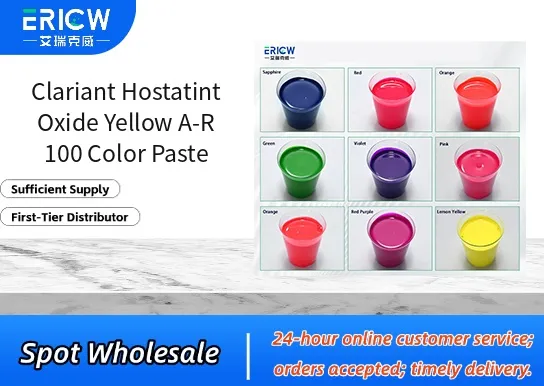
High chroma, lightfast yellow oxide pigment dispersion with excellent color strength.
Optimized for compatibility with water-based and solvent-based systems including acrylics, alkyds, and polyurethanes.
Low volatile organic compound (VOC) content, supporting sustainable formulation requirements.
Consistent rheology and excellent storage stability up to 24 months at 5–30 °C.
Free from heavy metals and REACH-compliant, meeting stringent regulatory standards for industrial coatings.
Architectural and industrial waterborne coatings.
Automotive refinish and OEM primer-surfacer systems.
Plastic masterbatch for rigid PVC and polyolefin applications.
Wood stains and transparent protective finishes.
General-purpose maintenance and corrosion-protection coatings.
| Chemical Type | Iron oxide-based inorganic pigment dispersion |
| Product Form | Ready-to-use liquid color paste |
| Appearance | Viscous, homogeneous yellow paste |
| Primary Applications | Water-based and solvent-based industrial coatings, plastic coloration |
| Key Features | High opacity, excellent dispersibility, low dusting risk |
| Benefits | Reduced formulation time, consistent batch-to-batch performance, improved tinting strength |
| Recommended Storage | 5–30 °C, protect from freezing and direct sunlight |
| Shelf Life | 24 months from date of manufacture under specified conditions |
Q1: What is the primary chemical composition of Hostatint Oxide Yellow A-R 100?
A: Hostatint Oxide Yellow A-R 100 is a pigment-based color paste formulated with inorganic iron oxide yellow pigments dispersed in a non-ionic, water-miscible vehicle system. It contains no heavy metals such as lead, cadmium, or chromium(VI), and is designed for compatibility with polar polymer systems.
Q2: Is this color paste suitable for use in food-contact plastics?
A: Hostatint Oxide Yellow A-R 100 is developed for applications where regulatory compliance is required; it meets general industry expectations for food-contact suitability in polyolefins and other common thermoplastics. However, final regulatory approval depends on the complete formulation, processing conditions, and end-use jurisdiction — users must conduct their own verification per applicable local regulations.
Q3: How should this paste be incorporated into polymer melts during compounding?
A: The paste is typically introduced via side-stuffer feeder or liquid injection system directly into the extruder barrel. Pre-drying of the base polymer is recommended to minimize moisture-related dispersion issues. Good melt homogenization time and moderate shear conditions generally support optimal pigment distribution.
Q4: Does this product exhibit good thermal stability during standard plastic processing?
A: Yes — the iron oxide yellow pigment system offers inherent thermal stability up to approximately 250 °C, making it suitable for conventional polyolefin, PS, and ABS processing. Performance may vary slightly depending on residence time and local temperature profiles within the processing equipment.
Q5: What are typical dosage levels when using this paste in polypropylene applications?
A: Dosage is formulation-dependent, but typical usage ranges from 0.1% to 2% by weight in polypropylene to achieve target shade intensity and opacity. Lower concentrations often suffice for pastel tones, while higher loadings may be used for deeper shades or improved hiding power — always confirm color consistency via lab-scale trials.
Contact With Us:
E-mail: wangxingqiang@ericwchem.com
Have a Questions? Call Us:
Add:
Building A1, Jiete Industrial Park, Huangpu District, Guangzhou City, Guangdong Province, China