English
 Español
 tiếng việt
 русский
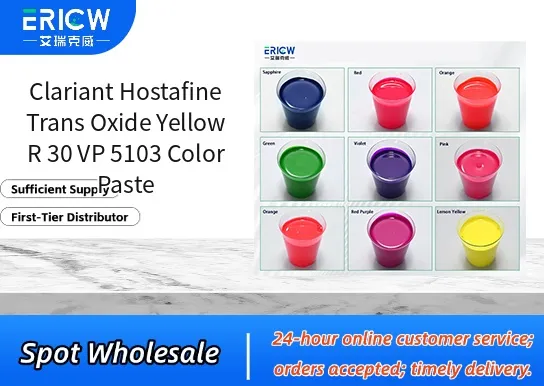
High chroma transparent yellow pigment dispersion with excellent lightfastness and weather resistance.
Optimized rheology for easy incorporation into solvent-based and high-solids coating systems.
Consistent batch-to-batch color strength and hue stability, ensuring reliable production performance.
Low volatile organic compound (VOC) content, supporting compliance with stringent environmental regulations.
Excellent compatibility with common acrylic, polyester, and alkyd resin systems.
Automotive OEM and refinish coatings requiring transparent yellow effects.
Industrial maintenance coatings for metal and plastic substrates.
Architectural and decorative coatings where color transparency and durability are critical.
Plastic coloring for injection-molded and extruded thermoplastics (e.g., ABS, PC, PS).
Wood coatings including clear lacquers and stains for furniture and flooring applications.
| Chemical Type | Organic pigment dispersion (transparent iron oxide-based) |
| Product Form | Liquid color paste |
| Appearance | Homogeneous, slightly viscous yellow liquid |
| Primary Applications | Coatings, plastics, wood finishes |
| Key Features | Transparency, lightfastness, thermal stability up to 180 °C |
| Benefits | Reduced formulation complexity, improved color consistency, low VOC |
| Solvent Base | Aromatic-free, low-odor hydrocarbon blend |
| Recommended Storage | 15–25 °C, avoid freezing and direct sunlight |
Q1: What types of polymers is this color paste compatible with?
A: Hostafine Trans Oxide Yellow R 30 VP 5103 is formulated for use in a broad range of thermoplastics, including polyolefins (PP, PE), PS, ABS, and engineering plastics such as PC and PA. It is not recommended for high-temperature processing above 300 °C without prior compatibility testing.
Q2: Does this product offer good thermal stability during extrusion or injection molding?
A: Yes — as a transparent iron oxide-based pigment system, it delivers excellent thermal stability under typical polymer processing conditions. Discoloration or significant hue shift is generally not observed below 280 °C, making it suitable for standard compounding and molding operations.
Q3: How should the color paste be dispersed in the final formulation?
A: Optimal dispersion is achieved using standard melt-mixing equipment such as twin-screw extruders. Pre-blending with carrier resin or masterbatch dilution is recommended to ensure uniform distribution. Avoid extended residence time at peak temperature to preserve transparency and color fidelity.
Q4: Is this product suitable for applications requiring lightfastness and weather resistance?
A: Yes — iron oxide pigments inherently provide strong resistance to UV radiation and atmospheric exposure. When properly compounded and protected within the polymer matrix, Hostafine Trans Oxide Yellow R 30 VP 5103 maintains good long-term color stability in both indoor and outdoor applications.
Q5: What is the typical dosage range for achieving target shade intensity?
A: Dosage depends on the base polymer, desired opacity/transparency level, and processing method, but typical usage generally ranges from 0.1% to 2% by weight relative to the total formulation. Lower concentrations are often sufficient due to its high tinctorial strength and transparency.
Contact With Us:
E-mail: wangxingqiang@ericwchem.com
Have a Questions? Call Us:
Add:
Building A1, Jiete Industrial Park, Huangpu District, Guangzhou City, Guangdong Province, China