English
 Español
 tiếng việt
 русский
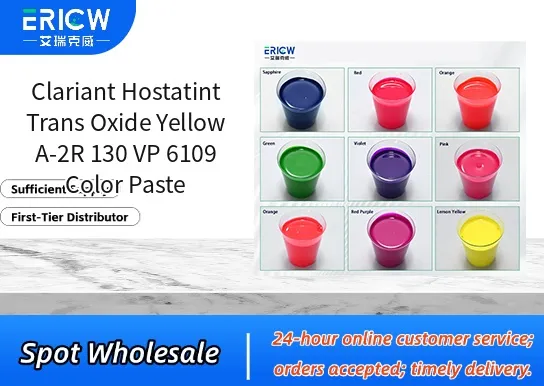
High chroma, transparent yellow shade with excellent lightfastness and weather resistance.
Optimized for high-gloss and clear-coat applications requiring color purity and minimal haze.
Excellent dispersion stability in solvent-based and high-solids automotive and industrial coatings.
Low volatile organic compound (VOC) formulation compliant with modern environmental regulations.
Consistent batch-to-batch color reproducibility supported by Clariant’s stringent quality control.
Automotive OEM basecoats and clearcoat systems.
Industrial maintenance coatings for metal and plastic substrates.
High-performance architectural coatings requiring durable exterior color.
Plastic coloration for automotive interior trim and consumer electronics housings.
| Chemical Type | Organic pigment dispersion (modified azo) |
| Product Form | Liquid color paste (solvent-based) |
| Appearance | Homogeneous, viscous yellow liquid |
| Primary Applications | Automotive coatings, industrial finishes, plastic coloration |
| Key Features | Transparency, high tinctorial strength, thermal stability up to 180°C |
| Benefits | Reduced let-down viscosity, improved jetness, compatibility with acrylic and polyester resins |
| Recommended Carrier Solvents | Xylene, Solvesso™ 100, butyl acetate, and high-boiling aromatic blends |
| Storage Conditions | Store at 15–25°C; protect from freezing and direct sunlight |
Q1: What types of polymers is this color paste compatible with?
A: Hostatint Trans Oxide Yellow A-2R 130 VP 6109 is formulated for use in a broad range of thermoplastics, including polyolefins (PP, PE), styrenics (PS, ABS), and engineering plastics such as PA and PC. Compatibility should always be verified under actual processing conditions due to formulation-specific interactions.
Q2: Is this product suitable for food-contact applications?
A: This color paste is not pre-approved for food-contact use. Regulatory compliance depends on the final application, polymer matrix, processing parameters, and applicable regional regulations. Customers must conduct full regulatory assessment—including migration testing if required—before use in food-contact articles.
Q3: How stable is the color during high-temperature processing?
A: The pigment system offers good thermal stability up to typical melt processing temperatures of polyolefins and styrenics. For extended residence times or higher-melting substrates (e.g., PBT, PET), performance should be confirmed via trial runs to ensure no significant hue shift or strength loss occurs.
Q4: What is the recommended dosage range for achieving standard opacity and shade intensity?
A: Dosage depends on the base polymer, desired shade depth, and optical requirements. For transparent or semi-transparent effects, it is typically used at low concentrations—generally ranging from 0.1% to 2% by weight—allowing fine control over chroma and transparency.
Q5: Does this paste require drying before use?
A: No pre-drying is required for standard processing. The paste is supplied in a carrier system designed for direct incorporation into molten polymer. However, storage under dry, cool conditions is recommended to maintain consistency and avoid moisture uptake over time.
Contact With Us:
E-mail: wangxingqiang@ericwchem.com
Have a Questions? Call Us:
Add:
Building A1, Jiete Industrial Park, Huangpu District, Guangzhou City, Guangdong Province, China