English
 Español
 tiếng việt
 русский
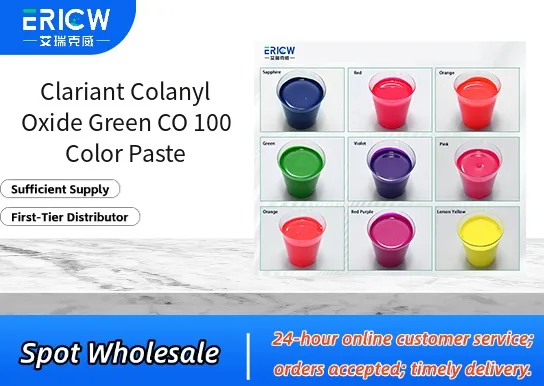
High chroma, consistent oxide green shade with excellent batch-to-batch reproducibility.
Optimized for compatibility with polyolefins, PVC, and engineering thermoplastics.
Low migration and outstanding thermal stability up to 240 °C during processing.
Free of heavy metals and compliant with major global regulatory frameworks including EU REACH and US FDA 21 CFR for indirect food contact applications.
Easy dispersion with minimal torque demand in standard compounding equipment.
Coloration of injection-molded automotive interior components.
Pigmentation of extruded profiles for building & construction applications.
Colored films and sheets for packaging and industrial labeling.
Masterbatch formulation for durable consumer goods and appliances.
Coloring of technical parts requiring UV resistance and long-term weatherability.
| Chemical Type | Metal oxide-based organic pigment dispersion |
| Product Form | Viscous paste (non-dusting) |
| Appearance | Homogeneous green paste, free of visible grit or separation |
| Primary Applications | Polyolefins (PP, HDPE), PVC, ABS, and engineering plastics |
| Key Features | Thermally stable, low volatility, high opacity |
| Benefits | Reduced filtration pressure, improved color consistency, extended equipment run time |
| Storage Conditions | Store at 15–25 °C; protect from freezing and direct sunlight |
| Shelf Life | 24 months from date of manufacture when stored properly |
Q1: What is the primary application of Colanyl Oxide Green CO 100?
A: Colanyl Oxide Green CO 100 is a high-performance pigment dispersion specifically developed for coloring polyolefin compounds—especially PP and HDPE—in applications requiring good thermal stability, low volatility, and consistent green hue under processing conditions.
Q2: Is this color paste suitable for food-contact plastics?
A: Colanyl Oxide Green CO 100 is formulated with components compliant with major global food-contact regulations for polyolefins, subject to final formulation validation. Users must confirm suitability for their specific end-use and regulatory jurisdiction through full system testing and compliance documentation review.
Q3: How should Colanyl Oxide Green CO 100 be incorporated into polymer melts?
A: It is typically added directly to the base polymer during compounding using standard twin-screw extrusion or high-shear mixing equipment. Pre-drying is not required, but optimal dispersion is achieved when dosed after the polymer has reached a stable melt temperature and viscosity.
Q4: Does this product offer resistance to migration and blooming in finished parts?
A: Yes—Colanyl Oxide Green CO 100 demonstrates excellent compatibility with polyolefins, minimizing surface migration and blooming under normal service temperatures and storage conditions. Performance may vary depending on polymer grade, additive package, and processing history.
Q5: What is the recommended dosage range for achieving target shade intensity?
A: Dosage is formulation-dependent, but typical use levels in polyolefins generally range from 0.1% to 2% by weight—lower concentrations often suffice for medium-to-dark green shades due to the paste’s high pigment loading and efficient dispersion.
Contact With Us:
E-mail: wangxingqiang@ericwchem.com
Have a Questions? Call Us:
Add:
Building A1, Jiete Industrial Park, Huangpu District, Guangzhou City, Guangdong Province, China