English
 Español
 tiếng việt
 русский
High thermal stability up to 800 °C, ensuring color integrity in high-temperature processing.
Excellent lightfastness and weather resistance, maintaining hue and opacity under prolonged UV exposure.
Non-toxic, heavy-metal-free formulation compliant with global regulatory standards including REACH and RoHS.
Superior dispersion performance in both aqueous and solvent-based systems without requiring specialized dispersants.
Consistent particle size distribution for uniform tinting strength and minimal batch-to-batch variation.
Architectural coatings and exterior masonry paints requiring long-term color retention.
Industrial maintenance coatings for steel structures and infrastructure projects.
Ceramic glazes and clay-based tile bodies fired at stoneware temperatures.
Plastic coloration for outdoor applications including PP and HDPE profiles.
Cementitious products such as colored concrete pavers and precast architectural elements.
| Chemical Type | Iron oxide-based inorganic pigment (Fe₂O₃–MnO complex) |
| Product Form | Free-flowing dry powder |
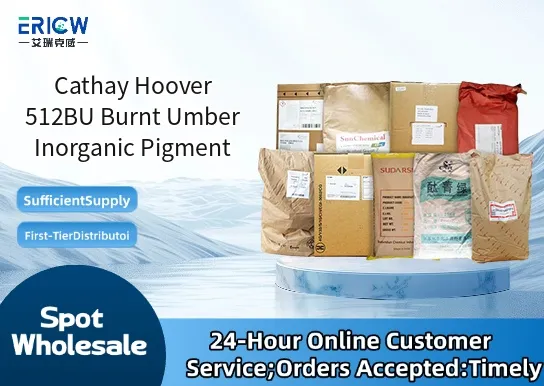
| Appearance | Uniform dark brown to burnt umber granular powder |
| Primary Applications | Coatings, plastics, ceramics, construction materials |
| Key Features | Heat stable, lightfast, chemically inert, non-volatile |
| Benefits | Low oil absorption, high tinting strength, excellent hiding power |
| pH (10% aqueous slurry) | 6.5–7.5 |
| Volatile Matter (105 °C, 2 hrs) | ≤0.5 wt% |
Q1: What is the primary chemical composition of Cathay Hoover 512BU?
A: Cathay Hoover 512BU is a synthetic inorganic pigment based on iron oxide, specifically formulated to deliver a rich, stable burnt umber hue. Its composition includes naturally derived and processed iron oxides with minor controlled additions of manganese and aluminum oxides to enhance chroma and thermal stability.
Q2: Is 512BU suitable for high-temperature applications such as ceramic glazes or powder coatings?
A: Yes — 512BU exhibits excellent thermal stability and retains its color integrity up to approximately 1000°C, making it well-suited for ceramic bodies, glazes, refractory materials, and thermoset powder coatings. Performance at elevated temperatures may vary depending on the host matrix and firing atmosphere.
Q3: How does 512BU compare to natural umber pigments in terms of consistency and dispersibility?
A: Unlike natural umber, which varies significantly in hue and impurity content between batches, 512BU offers superior batch-to-batch color consistency and particle size uniformity. Its engineered surface properties also support easier wetting and more efficient dispersion in both aqueous and solvent-based systems.
Q4: Can 512BU be used in UV-curable inks and coatings?
A: Yes — 512BU demonstrates good compatibility with common photoinitiator systems and shows minimal interference with UV curing kinetics. It is widely used in UV-flexo inks, screen printing inks, and clear-coat tinting where lightfastness and non-bleeding behavior are required.
Contact With Us:
E-mail: wangxingqiang@ericwchem.com
Have a Questions? Call Us:
Add:
Building A1, Jiete Industrial Park, Huangpu District, Guangzhou City, Guangdong Province, China