English
 Español
 tiếng việt
 русский
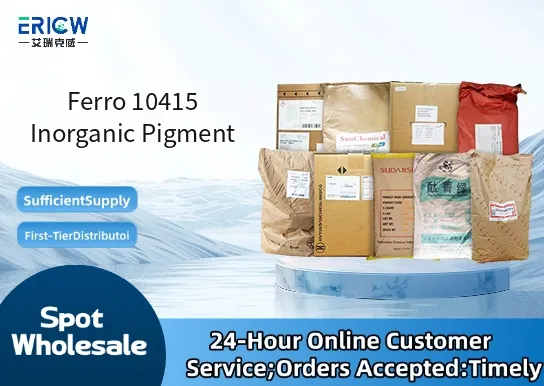
High thermal stability suitable for high-temperature processing up to 1200 °C.
Excellent chemical resistance against acids, alkalis, and solvents in demanding industrial environments.
Consistent color batch-to-batch reproducibility certified under ISO 9001 manufacturing controls.
Non-toxic formulation compliant with EU REACH and RoHS directives for restricted substances.
Optimized particle size distribution for enhanced dispersion and opacity in ceramic glazes and enamels.
Ceramic tile glazes requiring intense, stable red-brown hues.
Porcelain enamel coatings for domestic appliances and architectural steel substrates.
Sanitaryware glazes where long-term color retention under UV and thermal cycling is critical.
High-fire stoneware and vitrified clay bodies in architectural cladding applications.
Specialty refractory coatings for kiln furniture and furnace linings.
| Chemical Type | Mixed-metal oxide (Fe–Cr–Mn spinel system) |
| Product Form | Fine dry powder |
| Appearance | Free-flowing granular powder, dark reddish-brown |
| Primary Applications | Ceramic glazes, porcelain enamels, refractory coatings |
| Key Features | High temperature stability, acid/alkali resistance, non-volatile |
| Benefits | Color consistency, low sintering distortion, minimal volatilization loss |
| Storage Conditions | Store in cool, dry, well-ventilated area; protect from moisture |
| Regulatory Compliance | REACH registered; RoHS compliant; no heavy metal exemptions required |
Q1: What is the primary chemical composition of Ferro 10415?
A: Ferro 10415 is a mixed-metal oxide pigment, formulated primarily with iron, chromium, and aluminum oxides. Its inorganic structure provides inherent thermal stability and resistance to UV degradation.
Q2: Is Ferro 10415 suitable for food-contact plastics?
A: Yes — Ferro 10415 is designed for use in food-contact compliant plastic applications where regulatory approval of the final formulation is required. It meets applicable global requirements for inorganic pigments in polyolefins, PET, and engineering resins when used within recommended dosage ranges and processed under standard conditions.
Q3: How does Ferro 10415 perform under high-temperature processing?
A: This pigment exhibits excellent thermal stability and retains its color integrity during conventional melt processing of thermoplastics, including extrusion and injection molding at temperatures up to 300 °C. It shows minimal color shift or decomposition under typical residence times.
Q4: Can Ferro 10415 be used in polypropylene without causing blooming or plate-out?
A: When properly dispersed and compounded at appropriate loadings, Ferro 10415 demonstrates low tendency for blooming or plate-out in polypropylene. Optimal performance is achieved using standard masterbatch techniques and compatible carrier resins.
Q5: What are the recommended dispersion methods for achieving uniform color distribution?
A: For best results, Ferro 10415 should be incorporated via high-shear compounding — either as a pre-dispersed masterbatch or through direct addition with adequate mixing time and temperature control. Twin-screw extrusion is preferred over low-intensity blending methods to ensure full deagglomeration and homogeneity.
Contact With Us:
E-mail: wangxingqiang@ericwchem.com
Have a Questions? Call Us:
Add:
Building A1, Jiete Industrial Park, Huangpu District, Guangzhou City, Guangdong Province, China