English
 Español
 tiếng việt
 русский
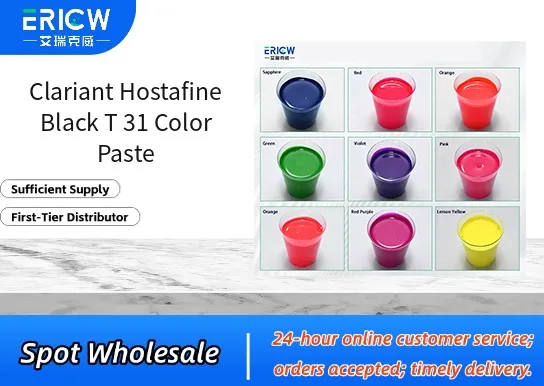
Highly concentrated black pigment dispersion for efficient coloration with low dosage.
Excellent compatibility with a broad range of thermoplastic and thermoset polymers.
Superior thermal stability suitable for high-temperature processing (e.g., injection molding, extrusion).
Consistent batch-to-batch color reproducibility and excellent dispersion performance.
Low volatile organic content (VOC) and compliant with major regulatory frameworks for plastics applications.
Automotive interior and exterior plastic components.
Packaging films and rigid containers for food-contact and non-food applications.
Household appliances and consumer electronics housings.
Engineering plastics used in industrial and technical parts.
Masterbatch production for polyolefins, ABS, PC, and PVC systems.
| Chemical Type | Carbon black-based pigment dispersion |
| Product Form | Viscous liquid color paste |
| Appearance | Jet-black, homogeneous paste |
| Primary Applications | Plastics coloring (thermoplastics & thermosets) |
| Key Features | High concentration, excellent dispersibility, thermal stability up to 280 °C |
| Benefits | Reduced dosing, minimal filter pressure build-up, consistent jetness and gloss |
| Recommended Carrier | Non-polar polymer-compatible carrier system (e.g., PP/PE-based) |
| Storage Conditions | Store in original sealed container at 15–25 °C; avoid freezing and direct sunlight |
Q1: What is the primary application field for Hostafine Black T 31 Color Paste?
A: Hostafine Black T 31 is primarily formulated for use in solvent-based and water-based industrial coatings, including automotive refinish, coil coatings, and general-purpose protective finishes where high jetness, good dispersion stability, and compatibility with common resin systems are required.
Q2: Is this color paste suitable for use in food-contact coatings?
A: Hostafine Black T 31 is not specifically designed or certified for direct food-contact applications. Its suitability for such uses must be evaluated case-by-case by the end-user in accordance with applicable regulatory requirements and final formulation testing.
Q3: How should Hostafine Black T 31 be incorporated into coating formulations?
A: It is typically added during the let-down or grinding stage using standard high-shear mixing equipment. Good wetting and gradual incorporation are recommended to ensure uniform dispersion and avoid agglomeration. Pre-dilution with a compatible solvent or resin solution may improve handling in some systems.
Q4: What are the key advantages of using this pigment paste over dry pigment powders?
A: Hostafine Black T 31 offers improved handling safety, reduced dust generation, consistent batch-to-batch color strength, and faster, more reproducible dispersion—leading to shorter production times and enhanced process reliability in industrial coating manufacturing.
Q5: Can Hostafine Black T 31 be used in UV-curable systems?
A: While it demonstrates reasonable compatibility with many UV-curable acrylate and epoxy-based resins, performance—including dispersion stability, cure speed, and final film appearance—must be validated under actual formulation and curing conditions due to system-specific interactions.
Contact With Us:
E-mail: wangxingqiang@ericwchem.com
Have a Questions? Call Us:
Add:
Building A1, Jiete Industrial Park, Huangpu District, Guangzhou City, Guangdong Province, China