English
 Español
 tiếng việt
 русский
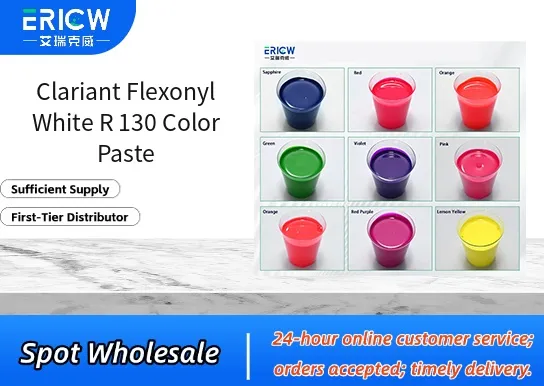
High-opacity titanium dioxide-based white pigment dispersion for superior hiding power.
Optimized rheology for excellent compatibility and easy incorporation into water-based systems.
Low VOC formulation compliant with stringent environmental and regulatory requirements.
Consistent batch-to-batch color strength and dispersion stability under standard storage conditions.
Designed for minimal filter bag clogging and reduced equipment wear during production.
Architectural coatings including interior and exterior wall paints.
Industrial maintenance coatings for metal and concrete substrates.
Water-based wood finishes and primers.
General-purpose decorative and protective coatings for DIY and professional use.
Coating formulations requiring high whiteness, brightness, and lightfastness.
| Chemical Type | Titanium dioxide (rutile) dispersion in aqueous medium |
| Product Form | Liquid color paste |
| Appearance | Opaque white paste, homogeneous and free of grit |
| Primary Applications | Water-based architectural and industrial coatings |
| Key Features | High opacity, low viscosity, excellent dispersion stability |
| Benefits | Improved tinting strength, reduced formulation complexity, enhanced gloss uniformity |
| pH (25 °C) | 7.5 – 8.5 |
| Storage Stability | 12 months at 5–30 °C in original sealed container |
Q1: What is Clariant Flexonyl White R 130 Color Paste primarily used for?
A: Flexonyl White R 130 is a high-performance, solvent-free color paste formulated for tinting flexible PVC, thermoplastic elastomers (TPE), and other non-polar polymer systems—especially where excellent dispersion, thermal stability, and consistent whiteness are required in calendered, extruded, or injection-molded applications.
Q2: Is this product suitable for food-contact or medical-grade applications?
A: Flexonyl White R 130 is not pre-qualified for direct food-contact or medical device applications. Its suitability for regulated end uses depends on full formulation evaluation, including compatibility with the base polymer and processing conditions. Customers must conduct appropriate regulatory testing and validation in their final application context.
Q3: How should Flexonyl White R 130 be incorporated into polymer compounds?
A: It is typically added during the compounding stage—either directly into the mixer or via masterbatch dilution. Due to its paste consistency and optimized rheology, it disperses readily under standard high-shear mixing conditions used for flexible PVC and TPEs. Pre-drying of the paste is not required.
Q4: Does this color paste contain heavy metals or restricted substances?
A: Flexonyl White R 130 is formulated without lead, cadmium, mercury, or hexavalent chromium, in alignment with Clariant’s commitment to responsible chemistry. It complies with major industry expectations for restricted substance management, though specific compliance status should be verified against current regional regulations and customer specifications.
Q5: What is the recommended dosage range for achieving optimal opacity and color strength?
A: Dosage depends on the base polymer, desired opacity level, and processing method, but it is generally effective at low concentrations—typically ranging from 0.1% to 2% by weight relative to the total compound. Optimal performance is achieved when dispersion is uniform and thermal history is controlled during processing.
Contact With Us:
E-mail: wangxingqiang@ericwchem.com
Have a Questions? Call Us:
Add:
Building A1, Jiete Industrial Park, Huangpu District, Guangzhou City, Guangdong Province, China