English
 Español
 tiếng việt
 русский
High chroma and excellent color strength for precise shade matching.
Excellent thermal stability suitable for high-temperature processing up to 280°C.
Good dispersibility in both polar and non-polar polymer matrices.
Low migration tendency, ensuring color fastness in end-use applications.
Free of heavy metals and compliant with major global regulatory frameworks (REACH, RoHS).
Polyolefin injection molding (PP, PE) for automotive interior components.
Extruded profiles and films in packaging and construction sectors.
Thermoplastic elastomer (TPE) compounds for consumer goods and medical devices.
Engineering plastics including ABS, PS, and PC for durable consumer electronics housings.
Masterbatch production for fiber and non-woven applications.
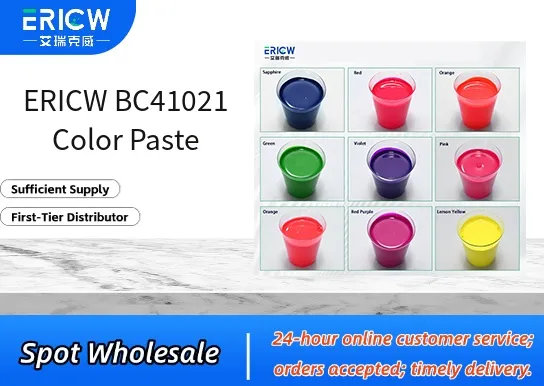
| Chemical Type | Organic pigment dispersion in polymeric carrier |
| Product Form | Viscous paste, semi-solid at room temperature |
| Appearance | Homogeneous, glossy paste with uniform consistency |
| Primary Applications | Polyolefins, engineering plastics, TPEs, and masterbatch systems |
| Key Features | High heat stability, low volatility, excellent batch-to-batch reproducibility |
| Benefits | Reduced dusting risk, improved handling safety, enhanced process efficiency |
| Storage Conditions | Store in sealed containers at 15–25°C; avoid direct sunlight and freezing |
| Shelf Life | 24 months from date of manufacture under recommended storage |
Q1: What types of polymer systems is ERICW BC41021 Color Paste compatible with?
A: ERICW BC41021 is formulated for use in thermoplastic polymers including polyolefins (PP, PE), ABS, PS, and certain engineering plastics. It demonstrates good dispersion stability during melt processing and is not recommended for high-temperature engineering resins requiring extended thermal exposure above 280°C.
Q2: How should ERICW BC41021 be incorporated into a compound or masterbatch?
A: It is typically added directly to the base polymer during extrusion or compounding using standard twin-screw equipment. Pre-blending with a portion of the carrier resin prior to feeding may improve dispersion uniformity. Avoid excessive shear or prolonged residence time at elevated temperatures to maintain color integrity.
Q3: Is ERICW BC41021 suitable for applications requiring food contact compliance?
A: ERICW BC41021 is designed for industrial and general-purpose coloring applications. It is not pre-certified for food-contact use; customers must conduct their own regulatory evaluation based on final formulation, processing conditions, and applicable regional requirements.
Q4: What is the typical dosage range for achieving target color intensity?
A: Dosage depends on the base polymer, desired shade depth, and processing method, but it is generally used at low concentrations — typically ranging from 0.1% to 2% by weight relative to the total formulation.
Contact With Us:
E-mail: wangxingqiang@ericwchem.com
Have a Questions? Call Us:
Add:
Building A1, Jiete Industrial Park, Huangpu District, Guangzhou City, Guangdong Province, China