English
 Español
 tiếng việt
 русский
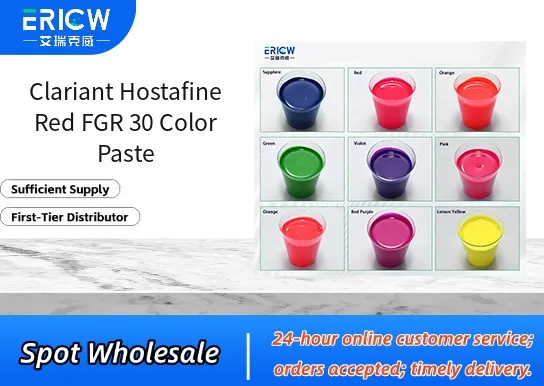
High chroma red shade with excellent lightfastness and thermal stability for demanding processing conditions.
Optimized rheology for easy dispersion in water-based systems without requiring high-shear mixing.
Low volatile organic compound (VOC) content, supporting compliance with stringent environmental and regulatory standards.
Consistent batch-to-batch color reproducibility, ensuring reliable color matching across production runs.
Non-bleeding formulation suitable for applications requiring migration resistance in polymer and coating matrices.
Water-based architectural and industrial coatings.
Interior and exterior decorative paints.
Waterborne wood stains and clear finishes.
Printing inks for packaging and labeling.
Specialty aqueous adhesives and sealants.
| Chemical Type | Azo pigment-based color paste |
| Product Form | Concentrated aqueous dispersion |
| Appearance | Viscous red paste, homogeneous and free of grit |
| Primary Applications | Water-based coatings, inks, and adhesives |
| Key Features | Good dispersibility, low VOC, non-bleeding |
| Benefits | Reduced formulation complexity, enhanced color consistency, regulatory compliance support |
| pH Range (25°C) | 7.5 – 8.5 |
| Storage Stability | 12 months at 5–30°C in sealed original container |
Q1: What is the primary application field for Hostafine Red FGR 30 Color Paste?
A: Hostafine Red FGR 30 is specifically developed for coloring polyolefin-based packaging materials, including flexible films, rigid containers, and injection-molded closures—particularly where high thermal stability and good dispersion are required during processing.
Q2: Is this color paste suitable for food-contact applications?
A: Yes, Hostafine Red FGR 30 is formulated to comply with global food-contact regulations for polyolefins, subject to proper end-use validation. Its compliance status should be confirmed against the specific regulatory framework applicable to your target market and final article type.
Q3: How does Hostafine Red FGR 30 perform under high-temperature processing conditions?
A: This paste exhibits excellent thermal stability, maintaining color integrity and minimal degradation during typical polyolefin processing—including extrusion, blow molding, and injection molding—at temperatures up to 280 °C.
Q4: What is the recommended dosage range for optimal coloration?
A: Dosage depends on the desired shade intensity and polymer matrix, but it is typically used at low concentrations—generally ranging from 0.1% to 2% by weight—due to its high tinctorial strength and efficient dispersion in polyolefins.
Contact With Us:
E-mail: wangxingqiang@ericwchem.com
Have a Questions? Call Us:
Add:
Building A1, Jiete Industrial Park, Huangpu District, Guangzhou City, Guangdong Province, China