English
 Español
 tiếng việt
 русский
High thermal stability up to 250 °C continuous service temperature.
Excellent UV and weather resistance for long-term outdoor performance.
Good compatibility with organic resins including acrylics, alkyds, and polyesters.
Low surface energy enabling superior water repellency and anti-graffiti properties.
Solvent-based formulation (xylene/toluene blend) for easy integration into conventional coating systems.
High-performance architectural coatings for façades and concrete protection.
Heat-resistant topcoats for industrial equipment and exhaust systems.
Water-repellent impregnation treatments for natural stone and masonry.
Hybrid silicone-acrylic exterior paints requiring enhanced durability and chalk resistance.
Anti-fouling and easy-clean coatings for infrastructure and transportation assets.
| Chemical Type | Methyl-phenyl silicone resin |
| Product Form | Liquid, solvent-based solution |
| Appearance | Clear, colorless to pale yellow liquid |
| Solvent Content | Approx. 60–65 wt% (xylene/toluene mixture) |
| Non-Volatile Content | 35–40 wt% |
| Viscosity (25 °C, DIN 53211) | 15–25 mPa·s |
| Density (20 °C) | 0.89–0.92 g/cm³ |
| Flash Point (PMCC) | Approx. 25 °C |
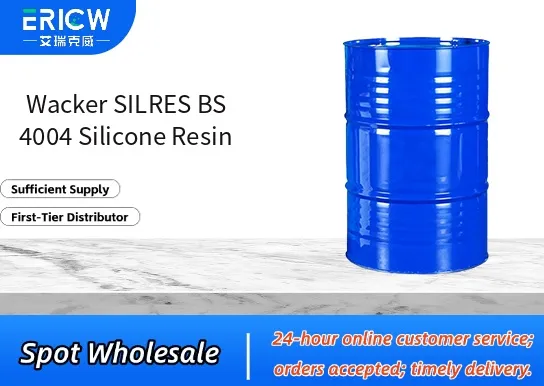
Q1: What is the primary function of SILRES BS 4004 in coating formulations?
A: SILRES BS 4004 is a methyl-phenyl silicone resin designed to enhance thermal stability, weather resistance, and surface hardness in high-performance organic coatings—especially for metal substrates exposed to elevated temperatures or harsh environmental conditions.
Q2: Is SILRES BS 4004 compatible with common organic resins such as acrylics, alkyds, or polyesters?
A: Yes, SILRES BS 4004 exhibits good compatibility with many thermosetting organic binders when properly dispersed or pre-mixed. Compatibility should be verified in the final formulation, as performance may vary depending on solvent system, curing conditions, and resin molecular weight.
Q3: How is SILRES BS 4004 typically incorporated into a coating system?
A: It is generally added during the let-down stage as a solution in aromatic or ketonic solvents. Pre-dilution and gradual addition under controlled agitation help ensure uniform dispersion and minimize viscosity spikes.
Q4: Does SILRES BS 4004 require heat curing to develop its full performance benefits?
A: While it contributes functionality even at ambient temperatures, optimal crosslinking and maximum thermal/chemical resistance are achieved through thermal curing—typically above 150 °C—enabling co-condensation with other silanol-containing components or organic resins.
Q5: Can SILRES BS 4004 improve substrate adhesion in silicone-modified coatings?
A: It primarily enhances film integrity and topcoat durability rather than acting as an adhesion promoter. For improved interfacial adhesion—particularly on low-surface-energy substrates—complementary additives or primer systems are recommended.
Contact With Us:
E-mail: wangxingqiang@ericwchem.com
Have a Questions? Call Us:
Add:
Building A1, Jiete Industrial Park, Huangpu District, Guangzhou City, Guangdong Province, China