English
 Español
 tiếng việt
 русский
Highly selective oxidation catalyst for improved process efficiency and reduced by-product formation.
Thermally stable formulation enabling reliable performance under demanding industrial operating conditions.
Low metal leaching characteristics ensuring long catalyst life and minimized downstream contamination.
Customizable support and active phase composition to match specific reactor configurations and feedstock profiles.
Environmentally optimized design compliant with evolving regulatory requirements for sustainable chemical manufacturing.
Selective oxidation of alcohols to aldehydes and ketones in fine chemical synthesis.
Epoxidation of olefins for production of epoxy resins and pharmaceutical intermediates.
Oxidative dehydrogenation (ODH) of light alkanes in petrochemical derivative manufacturing.
Catalytic air pollution control in VOC abatement systems for chemical processing exhaust streams.
Green hydrogen peroxide (H₂O₂) utilization pathways in low-waste oxidation processes.
| Chemical Type | Heterogeneous transition metal oxide catalyst (e.g., Co–Mn–Ce based) |
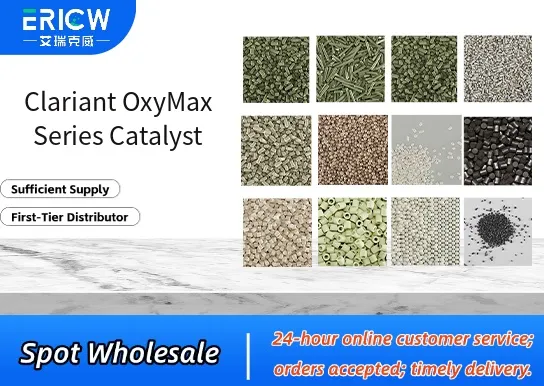
| Product Form | Extruded pellets or spherical granules |
| Appearance | Gray to black free-flowing solid particles |
| Primary Applications | Gas-phase and liquid-phase selective oxidation reactions |
| Key Features | High oxygen mobility, tunable acid–base properties, robust thermal stability |
| Benefits | Extended cycle life, reduced catalyst replacement frequency, lower total cost of ownership |
| Storage Conditions | Store in dry, well-ventilated area; avoid exposure to moisture and strong oxidizers |
| Handling Precautions | Use appropriate PPE; consult SDS for dust control and disposal guidelines |
Q1: What is the primary function of the OxyMax Series Catalyst in polymer processing?
A: The OxyMax Series Catalyst is designed to accelerate oxidative degradation of polyolefins under controlled thermal and atmospheric conditions—enabling efficient, targeted polymer chain scission for applications such as controlled rheology modification or recycling support.
Q2: Is OxyMax compatible with common polyolefin resins like PP and HDPE?
A: Yes, OxyMax catalysts are formulated for compatibility with a broad range of polyolefins, including homopolymer and copolymer polypropylene (PP), high-density polyethylene (HDPE), and linear low-density polyethylene (LLDPE), and are typically incorporated via melt compounding.
Q3: How is OxyMax typically dosed during compounding?
A: Dosage depends on formulation requirements and target molecular weight reduction, but OxyMax is generally used at low concentrations—typically ranging from 0.1% to 2% by weight relative to the base polymer—and is often pre-dispersed or masterbatched for uniform distribution.
Q4: Does OxyMax require special handling or storage conditions?
A: To maintain optimal performance, OxyMax should be stored in its original sealed packaging under cool, dry conditions, protected from moisture and direct sunlight. Avoid prolonged exposure to ambient humidity prior to processing.
Q5: Can OxyMax be used in food-contact or medical-grade polymer applications?
A: OxyMax is not intended for use in final food-contact or medical devices unless explicitly approved through independent regulatory assessment and supported by full compliance documentation—users must verify suitability per applicable regional regulations and end-use requirements.
Contact With Us:
E-mail: wangxingqiang@ericwchem.com
Have a Questions? Call Us:
Add:
Building A1, Jiete Industrial Park, Huangpu District, Guangzhou City, Guangdong Province, China