English
 Español
 tiếng việt
 русский
Highly selective for polyolefin polymerization with minimized atactic by-product formation.
Excellent thermal and mechanical stability under continuous industrial reactor conditions.
Tailored morphology for consistent particle replication and reduced fouling in gas-phase and slurry processes.
Low heavy-metal content ensuring compliance with stringent regulatory requirements for food-contact and medical-grade resins.
Compatible with common co-catalysts including methylaluminoxane (MAO) and modified alkylaluminum compounds.
Production of high-melt-strength polypropylene (HMS-PP) for thermoformed packaging and automotive interior parts.
Manufacture of impact-resistant polypropylene copolymers used in durable consumer goods and appliances.
Synthesis of isotactic polypropylene for fiber applications including spunbond and meltblown nonwovens.
Enabling controlled molecular weight distribution in catalytic olefin block copolymer (OBC) synthesis.
| Chemical Type | Heterogeneous Ziegler–Natta catalyst system |
| Product Form | Free-flowing microspherical powder |
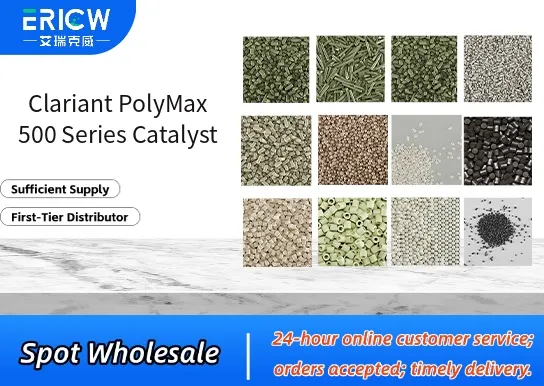
| Appearance | Light gray to beige granular solid |
| Primary Applications | Polypropylene and ethylene-propylene copolymer production |
| Key Features | High activity, stereoselectivity, and hydrogen response |
| Benefits | Improved process efficiency, lower catalyst residue, enhanced resin clarity |
| Storage Conditions | Under inert atmosphere (N₂ or Ar), dry, below 25 °C |
| Handling Precautions | Air-sensitive; use only in glovebox or purged systems |
Q1: What is the primary function of the PolyMax 500 Series in polyolefin processing?
A: The PolyMax 500 Series is a high-performance metallocene-based catalyst system designed to enable precise control over polymer microstructure—particularly in ethylene/α-olefin copolymerization—yielding resins with narrow molecular weight distribution, uniform comonomer incorporation, and enhanced mechanical properties.
Q2: How does the PolyMax 500 Series differ from conventional Ziegler–Natta catalysts?
A: Unlike traditional Ziegler–Natta systems, PolyMax 500 catalysts feature single-site active centers, resulting in greater catalytic efficiency, superior stereoselectivity, and consistent polymer architecture—enabling tailored resin performance without requiring complex post-polymerization blending or additives.
Q3: Is the PolyMax 500 Series suitable for use in gas-phase and slurry-phase polyolefin processes?
A: Yes—the PolyMax 500 Series is engineered for compatibility with major industrial polyolefin process technologies, including gas-phase fluidized-bed reactors and liquid-phase slurry systems, and demonstrates robust activity and particle morphology control under standard operating conditions.
Q4: What handling precautions should be observed when working with PolyMax 500 catalysts?
A: As with all highly active organometallic catalysts, PolyMax 500 materials must be handled under strict inert-atmosphere conditions (e.g., nitrogen or argon), protected from moisture, oxygen, and ambient light. Storage requires temperature-controlled, sealed containers, and personnel should follow Clariant’s Safety Data Sheet (SDS) guidance for safe handling and disposal.
Q5: Can PolyMax 500 catalysts be used to produce impact-resistant polypropylene copolymers?
A: Yes—when applied in controlled reactor configurations (e.g., multi-stage or cascade systems), PolyMax 500 catalysts support the production of heterogeneous and random propylene–ethylene copolymers with balanced stiffness–toughness profiles, commonly used in automotive and durable goods applications.
Contact With Us:
E-mail: wangxingqiang@ericwchem.com
Have a Questions? Call Us:
Add:
Building A1, Jiete Industrial Park, Huangpu District, Guangzhou City, Guangdong Province, China