English
 Español
 tiếng việt
 русский
Excellent abrasion resistance for demanding mechanical service conditions.
Outstanding elasticity and recovery performance after repeated deformation.
Good processability in injection molding and extrusion operations.
Enhanced hydrolytic stability compared to conventional polyester-based TPUs.
Low-temperature flexibility down to –30 °C without significant loss of toughness.
Automotive interior trim components including instrument panel skins and door inserts.
Industrial hoses and pneumatic tubing requiring dynamic flex life and pressure resistance.
High-performance footwear midsoles and outsoles for athletic and work footwear.
Consumer electronics protective cases and soft-touch overmolded grips.
Medical device housings and non-implantable wearable components compliant with ISO 10993-5.
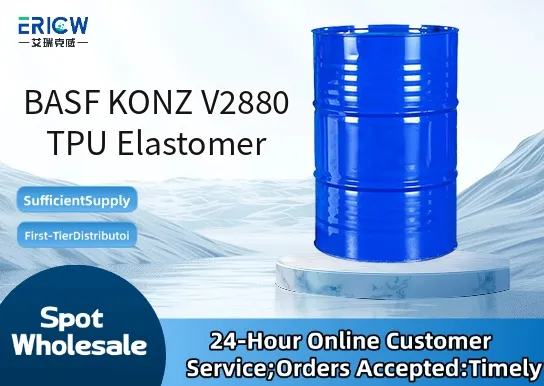
| Chemical Type | Thermoplastic Polyurethane (TPU), polyester-based |
| Product Form | Pellets |
| Appearance | Off-white to light beige, free-flowing granules |
| Hardness (Shore A) | 85 ± 2 |
| Melt Flow Index (230 °C / 2.16 kg) | 10–14 g/10 min |
| Density | 1.18–1.20 g/cm³ |
| Primary Applications | Soft-touch overmolding, flexible functional parts, dynamic sealing elements |
| Key Features | High elasticity, low compression set, good UV resistance (with stabilization) |
Q1: What is the primary function of BASF KONZ V2880 in TPU formulations?
A: BASF KONZ V2880 is a specialized processing aid designed to improve melt flow and reduce extrusion torque during TPU compounding and processing. It enhances surface finish, reduces die buildup, and supports stable high-speed production without compromising mechanical performance.
Q2: Is KONZ V2880 compatible with all major TPU chemistries (e.g., polyester-, polyether-, and polycaprolactone-based)?
A: Yes, KONZ V2880 demonstrates broad compatibility across aromatic and aliphatic TPU systems, including polyester-, polyether-, and polycaprolactone-based grades. Compatibility should be confirmed via small-scale trials under actual processing conditions due to formulation-specific interactions.
Q3: How does KONZ V2880 affect the final TPU’s mechanical properties and thermal stability?
A: When used at recommended dosage levels, KONZ V2880 typically has minimal impact on tensile strength, elongation, or hardness. It does not significantly alter the thermal decomposition profile or long-term heat aging behavior of standard TPU compounds, provided it is uniformly dispersed and thermally stabilized within the system.
Q4: Can KONZ V2880 be used in applications requiring food contact or skin-safe compliance?
A: KONZ V2880 is not pre-qualified for direct food contact or dermal applications. Its suitability for regulated end uses depends on full formulation assessment, migration testing, and compliance verification by the compounder or end-user against applicable regional regulatory frameworks.
Contact With Us:
E-mail: wangxingqiang@ericwchem.com
Have a Questions? Call Us:
Add:
Building A1, Jiete Industrial Park, Huangpu District, Guangzhou City, Guangdong Province, China