English
 Español
 tiếng việt
 русский
Excellent balance of elasticity and melt processability for efficient extrusion and injection molding.
Superior soft-touch feel with high resilience and low permanent set after deformation.
Good compatibility with polypropylene (PP) and polyethylene (PE), enabling robust overmolding adhesion.
Enhanced UV and thermal stability for improved outdoor durability and long-term performance.
Halogen-free formulation compliant with RoHS and REACH regulatory requirements.
Automotive interior trim components including door panels, armrests, and console covers.
Consumer electronics housings and protective grips for power tools and handheld devices.
Medical device grips and ergonomic handles requiring skin-safe, non-slip surfaces.
Household appliance seals, gaskets, and soft-touch control buttons.
Industrial tool overmolded handles for enhanced shock absorption and user comfort.
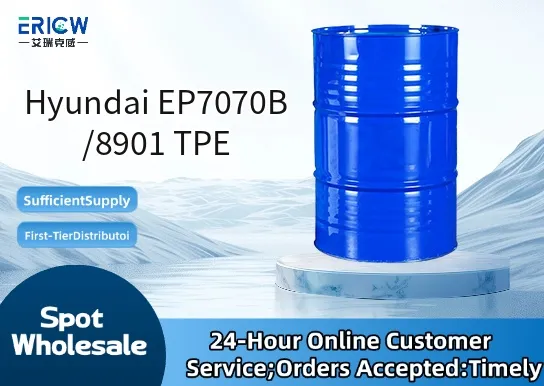
| Chemical Type | Thermoplastic Elastomer (TPE) – PP-based thermoplastic vulcanizate (TPV) |
| Product Form | Pellets |
| Appearance | Off-white to light beige granules |
| Hardness (Shore A) | 70 ± 3 |
| Melt Flow Rate (230°C/2.16 kg) | 15–22 g/10 min |
| Density | 0.98–1.02 g/cm³ |
| Key Features | Oil-resistant, weather-resistant, recyclable |
| Primary Applications | Overmolding, soft-touch components, dynamic sealing |
Q1: What is the primary application of Hyundai EP7070B/8901 TPE?
A: Hyundai EP7070B/8901 TPE is a thermoplastic elastomer specifically engineered for soft-touch overmolding and functional grip applications—commonly used in automotive interior components, power tool housings, and consumer electronics accessories where durability, tactile comfort, and adhesion to rigid substrates like PP or ABS are required.
Q2: Is EP7070B/8901 TPE compatible with common injection molding equipment?
A: Yes, it is fully processable on standard injection molding machines. It requires typical TPE drying (e.g., 60–80 °C for 2–4 hours) and mold temperatures generally ranging from 20 °C to 40 °C. Melt temperature should be maintained between 170 °C and 210 °C depending on part geometry and cycle requirements.
Q3: How does EP7070B/8901 perform in terms of adhesion to polypropylene (PP)?
A: It exhibits strong inherent adhesion to untreated PP substrates without requiring primers or surface treatments—making it suitable for two-shot molding processes. Bond strength is optimized when processing parameters (e.g., melt temperature, mold temperature, and injection speed) are aligned with Hyundai’s recommended guidelines.
Q4: Does this grade meet regulatory requirements for consumer-facing products?
A: Hyundai EP7070B/8901 TPE is formulated without intentionally added heavy metals, phthalates, or halogenated flame retardants. It complies with general global safety expectations for consumer goods and is commonly selected for applications requiring RoHS and REACH conformity—though final compliance verification remains the responsibility of the compounder or end-user based on full formulation and intended use.
Contact With Us:
E-mail: wangxingqiang@ericwchem.com
Have a Questions? Call Us:
Add:
Building A1, Jiete Industrial Park, Huangpu District, Guangzhou City, Guangdong Province, China