English
 Español
 tiếng việt
 русский
Excellent melt processability for extrusion, injection molding, and blow molding
High tensile strength and elongation at break for demanding dynamic applications
Outstanding abrasion resistance and low-temperature flexibility down to –30 °C
Good resistance to oils, greases, and non-polar solvents
Hydrolysis-stabilized formulation for enhanced long-term performance in humid environments
Automotive interior trim and soft-touch components
Industrial hoses and fluid-conveying tubing
Footwear midsoles and outsole compounds
Wire and cable jacketing for flexible, durable insulation
Medical tubing requiring biocompatibility support (ISO 10993-compliant base polymer)
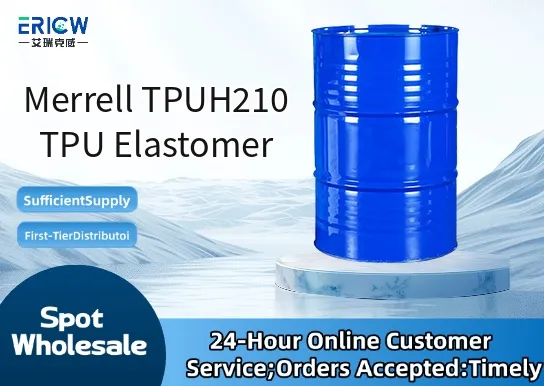
| Chemical Type | Thermoplastic Polyurethane (Aliphatic Polyester-based) |
| Product Form | Pellets |
| Appearance | Off-white to light beige, free-flowing granules |
| Density (g/cm³) | 1.18–1.22 |
| Melt Flow Index (210 °C / 5 kg) | 10–14 g/10 min |
| Tensile Strength (MPa) | 32–38 |
| Elongation at Break (%) | 550–620 |
| Shore A Hardness | 85–88 |
Q1: What is the primary application profile for Merrell TPUH210?
A: Merrell TPUH210 is a thermoplastic polyurethane elastomer designed for demanding flexible compound applications—particularly in high-performance thermoplastic elastomer (TPE) blends, soft-touch overmolding, and durable film or sheet extrusion where excellent melt processability, resilience, and low-temperature flexibility are required.
Q2: Is Merrell TPUH210 compatible with common engineering thermoplastics such as PP, ABS, or PC?
A: Yes—TPUH210 exhibits good compatibility with a range of semi-crystalline and amorphous thermoplastics when used as a compatibilizer or impact modifier. It is frequently incorporated into PP and ABS blends to enhance toughness and surface feel, though optimal performance requires careful attention to processing conditions and interfacial adhesion.
Q3: How does Merrell TPUH210 perform under thermal processing conditions like extrusion or injection molding?
A: TPUH210 offers stable melt rheology and low thermal degradation risk within typical TPU processing windows (170–220 °C). Its narrow molecular weight distribution supports consistent flow behavior and minimizes die swell, making it well-suited for precision extrusion and thin-wall injection molding applications.
Q4: Can Merrell TPUH210 be used in applications requiring regulatory compliance for food contact or skin contact?
A: While TPUH210 is formulated without intentionally added heavy metals or plasticizers of concern, formal regulatory clearance depends on final formulation, processing history, and end-use conditions. Customers intending food-contact or dermal-contact applications should conduct full compliance verification per applicable regional requirements.
Contact With Us:
E-mail: wangxingqiang@ericwchem.com
Have a Questions? Call Us:
Add:
Building A1, Jiete Industrial Park, Huangpu District, Guangzhou City, Guangdong Province, China