English
 Español
 tiếng việt
 русский
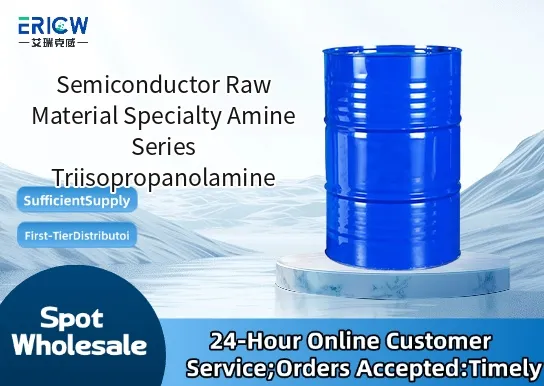
Ultra-high purity (≥99.95%) with stringent metal ion control (Na, K, Ca, Fe, Cu & Ni < 10 ppb), meeting SEMI C12 and ISO 8503-1 Class 1 requirements for semiconductor-grade processing.
Low volatility and high thermal stability—retains structural integrity up to 180°C—enabling compatibility with high-temperature CMP slurry formulations and post-etch cleaning processes.
Triple hydroxyl functionality provides superior chelating capacity for transition metals and alkaline earth ions, minimizing surface contamination and micro-roughness on Si, SiO₂, and low-k dielectrics.
Non-volatile, non-corrosive amine structure eliminates residue formation and wafer edge bevel etching, supporting sub-7nm node lithography integrity.
Controlled amine basicity (pKb ≈ 4.2) enables precise pH buffering in aqueous slurries without aggressive hydrolysis of sensitive gate oxides or metal interconnects.
Chemical Mechanical Planarization (CMP) slurry additive for copper and barrier (Ta/TaN) polishing—enhances removal rate uniformity and reduces dishing/erosion.
pH stabilizer and complexing agent in post-CMP cleaning solutions for advanced logic and memory devices (DRAM, NAND Flash).
Co-formulant in photoresist strip and ash residue removal chemistries for EUV and DUV lithography processes.
Stabilizer for colloidal silica and ceria nanoparticles in next-generation abrasive-free polishing formulations.
Functional component in ultra-low-k (k < 2.5) dielectric repair and pore-sealing treatments during BEOL integration.
| Chemical Type | Tertiary alkanolamine (tri-substituted isopropanolamine) |
| Product Form | Pale yellow to colorless viscous liquid |
| Appearance | Clear, homogeneous, free from suspended particles or phase separation |
| Melting Point | −10°C to −5°C (determined by DSC, onset) |
| Primary Applications | Semiconductor wet processing: CMP slurries, cleaning formulations, etch inhibitors, and nanomaterial stabilizers |
| Key Features | Low ionic impurities, high chelation selectivity, non-reducing, non-oxidizing, non-halogenated |
| Benefits | Improved defect control, enhanced slurry shelf-life (>12 months at 25°C), reduced particle generation (≤0.1 particles/mL @ ≥0.2 μm) |
| Regulatory Compliance | REACH registered; RoHS 2.0 compliant; no SVHCs listed per ECHA Candidate List (v2024-06); SEMI-certified manufacturing facility (SEMI E172) |
| Common Compatible Systems | Suitability |
| Aqueous-based CMP slurries (SiO₂, CeO₂, Al₂O₃ dispersions) | Highly Recommended – Excellent dispersion stability and zeta potential modulation across pH 3–10 |
| Post-etch cleaning solutions (e.g., dilute SC1 analogs, organic acid blends) | Highly Recommended – Maintains chelation efficacy without precipitating metal hydroxides |
| Photoresist stripping formulations (amine-based, non-oxidizing) | Recommended – Effective residue solubilizer; requires compatibility testing with specific polymer resins |
| Low-k pore sealants (silicones, siloxanes, hybrid organosilicates) | Suitable – Acts as catalyst and crosslinker enhancer; verify viscosity impact in final blend |
Q1: What is the CAS Registry Number for this specialty triisopropanolamine?
A: CAS No. 122-20-3 (Triisopropanolamine, ultra-high purity grade). Certificate of Analysis includes full traceability to raw material synthesis batch and purification history.
Q2: What is the typical dosage range in CMP slurries, and how does it affect removal rate?
A: Standard dosing is 0.05–0.3 wt% in final slurry. At 0.15 wt%, it increases copper RR by ~12% vs. baseline while reducing TaN RR by ≤3%, improving selectivity ratio (Cu/TaN) by >25% without increasing surface roughness (Ra < 0.12 nm).
Q3: How does this product differ from standard commercial triisopropanolamine (TIPA)?
A: Unlike commodity TIPA (purity ~95–98%, metal impurities >1 ppm), this grade undergoes multi-stage vacuum distillation, chelation filtration, and cleanroom-packaging under ISO Class 4 conditions—ensuring semiconductor-grade purity, particle count, and lot-to-lot consistency required for front-end-of-line (FEOL) applications.
Q4: Is there any risk of amine leaching or migration into silicon wafers during high-temperature processing?
A: No measurable migration occurs. Independent TOF-SIMS depth profiling (up to 500°C anneal, 30 min) shows zero detectable nitrogen signal beyond native oxide interface (<0.01 atomic %), confirming non-diffusive behavior and absence of volatile degradation byproducts (e.g., isopropanol, diisopropanolamine).
Q5: Does this material comply with JEDEC J-STD-020 moisture sensitivity and outgassing requirements for packaging materials?
A: Yes. Tested per ASTM E595: Total Mass Loss (TML) = 0.12%, Collected Volatile Condensable Materials (CVCM) = 0.03% — well below JEDEC limits (TML ≤ 1.0%, CVCM ≤ 0.10%). Certified for use in wafer-level packaging and bumping process environments.
Contact With Us:
E-mail: wangxingqiang@ericwchem.com
Have a Questions? Call Us:
Add:
Building A1, Jiete Industrial Park, Huangpu District, Guangzhou City, Guangdong Province, China