English
 Español
 tiếng việt
 русский
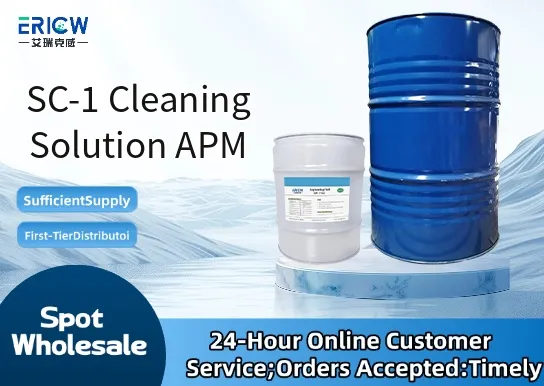
Highly effective at removing organic residues, photoresist residuals, and trace metal contaminants from silicon wafers and precision substrates.
Engineered for consistent performance in automated wet bench and single-wafer cleaning systems with minimal particle generation.
Stable alkaline formulation based on standard SC-1 chemistry (NH₄OH:H₂O₂:H₂O), optimized for controlled etch rate and surface passivation.
Low metallic impurity profile (<10 ppt for Na, K, Fe, Cu, Ni) meeting SEMI C1/C37 purity requirements for advanced node fabrication.
Ready-to-dilute concentrate format enables precise onsite preparation and reduces logistics footprint versus pre-mixed solutions.
Front-end-of-line (FEOL) wafer cleaning prior to gate oxide growth and epitaxial deposition.
Post-etch and post-CMP residue removal in 28 nm to 3 nm semiconductor manufacturing processes.
Cleaning of MEMS, compound semiconductor (GaAs, SiC, GaN), and advanced packaging substrates (RDL, TSV).
Optical component cleaning for photomask blanks and lithography optics requiring ultra-low particle adders.
Research & development applications in university cleanrooms and pilot-line fabs requiring reproducible SC-1 benchmarking.
| Chemical Type | Aqueous alkaline peroxide mixture (NH₄OH/H₂O₂/H₂O) |
| Product Form | Concentrated liquid (ready-to-dilute) |
| Appearance | Clear, colorless to pale yellow liquid |
| pH (1:5 dilution in DI water, 25°C) | 10.2–10.8 |
| Primary Applications | Organic residue removal, particle reduction, light metal contaminant stripping |
| Key Features | Low particle count (<5 particles/mL @ ≥0.2 μm), low halide content (<5 ppb Cl⁻), high stability (≥12 months unopened) |
| Benefits | Reduced rework rates, improved yield in critical layers, compatibility with high-k/metal gate stacks |
| Regulatory Compliance | REACH compliant; SDS available; no SVHCs above 0.1% w/w; non-hazardous for transport (UN3082 not applicable) |
| Common Compatible Systems | Suitability |
| SEZ Spin Rinse Dryer (SRD) | Highly Recommended – Validated for <10 Å/Si etch uniformity and sub-5 nm RMS roughness |
| Screen Semiconductor Wet Processing Tools | Highly Recommended – Fully compatible with SmartClean™ and EcoLine® platforms |
| Technics Wafer Clean Systems (e.g., TC-3000) | Recommended – Requires standard temperature/flow calibration per tool manual |
| Modutek PFA Tank-Based Batch Systems | Suitable – Compatible with PFA, quartz, and high-purity PVC wetted materials |
Q1: What is the CAS Registry Number for SC-1 Cleaning Solution APM?
A: SC-1 Cleaning Solution APM is a formulated mixture and does not have a single CAS number. Its primary constituents are ammonium hydroxide (CAS 1336-21-6), hydrogen peroxide (CAS 7722-84-1), and deionized water (CAS 7732-18-5). Full compositional disclosure is provided in the Safety Data Sheet (SDS).
Q2: What is the recommended working concentration and temperature range?
A: Standard working dilution is 1:1:5 (NH₄OH:H₂O₂:H₂O) at 70–80°C. For advanced nodes (<10 nm), a reduced ratio (0.5:1:5) at 65°C is recommended to minimize silicon loss while maintaining particle removal efficiency.
Q3: How does SC-1 Cleaning Solution APM compare to generic SC-1 or competitor formulations?
A: Unlike generic SC-1, APM is manufactured under ISO 9001/14001-certified clean production with real-time ICP-MS lot release testing. It demonstrates ≤30% lower metallic leaching from quartz/PFA components and superior repeatability in particle removal efficiency (CV < 2.1% across 50 consecutive runs).
Q4: Is SC-1 Cleaning Solution APM certified for use in ISO Class 1 cleanrooms and qualified under SEMI S2/S8?
A: Yes — all production lots undergo full SEMI S2 (safety) and S8 (ergonomics) assessment. The product is certified for ISO Class 1 environments when handled using Class 1-compatible dispensing systems and validated filtration (0.05 μm PTFE).
Q5: Does SC-1 Cleaning Solution APM cause extractables or leachables in PFA or quartz process lines?
A: No significant extractables were detected in accordance with USP <87> and <88> cytotoxicity testing. Independent LC-MS analysis confirmed <0.5 ppb total organic extractables after 72-hour static exposure to PFA tubing at 80°C.
Contact With Us:
E-mail: wangxingqiang@ericwchem.com
Have a Questions? Call Us:
Add:
Building A1, Jiete Industrial Park, Huangpu District, Guangzhou City, Guangdong Province, China