English
 Español
 tiếng việt
 русский
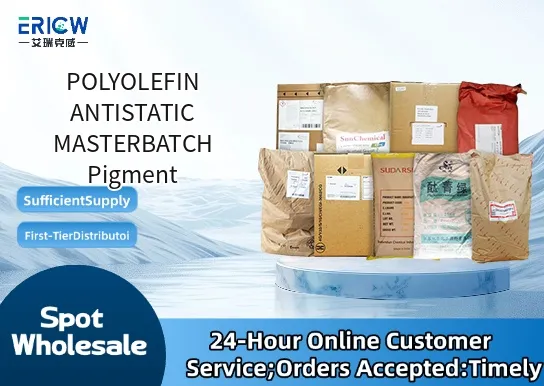
Effective static dissipation for polyolefin-based polymers including PP and PE.
Compatible with standard extrusion, injection molding, and blow molding processes.
Non-migrating, permanent antistatic performance without surface blooming or dust attraction.
Heat-stable formulation suitable for processing temperatures up to 280°C.
Customizable pigment loadings to achieve target color intensity while maintaining antistatic functionality.
Antistatic packaging films for electronics and semiconductor handling.
Static-safe containers and trays used in cleanroom and medical device manufacturing.
Automotive interior components requiring ESD protection and consistent coloration.
Industrial HDPE/PP pipes and fittings for pneumatic conveying systems.
Consumer goods such as toolboxes, storage bins, and appliance housings.
| Chemical Type | Internal antistatic agent + organic pigment dispersion |
| Product Form | Free-flowing granules |
| Appearance | Uniform colored pellets (custom color options available) |
| Carrier Resin | Homopolymer polypropylene (PP) or linear low-density polyethylene (LLDPE), matched to base polymer |
| Recommended Loading Range | 1.5–5.0 wt% depending on substrate and performance requirements |
| Specific Gravity | 0.90–1.05 (varies by pigment type) |
| Volatiles Content (105°C, 2 hrs) | <0.3 wt% |
| Key Features | ESD-safe, FDA-compliant options available, RoHS & REACH compliant |
Q1: What polyolefin resins is this masterbatch compatible with?
A: This masterbatch is specifically formulated for use with polypropylene (PP) and polyethylene (PE), including HDPE, LDPE, and LLDPE. It demonstrates excellent dispersion and compatibility in both homopolymer and copolymer systems during standard melt processing.
Q2: How does the antistatic performance develop after processing?
A: Antistatic functionality becomes effective upon extrusion or molding, as the active components migrate to the polymer surface over time. Performance stabilizes within hours to days under ambient conditions and is maintained throughout the product’s service life under typical indoor storage and handling environments.
Q3: Can this masterbatch be used in applications requiring color consistency and low haze?
A: Yes — it combines pigment dispersion with antistatic functionality while maintaining good color fidelity and optical clarity in thin-section parts. Haze impact is minimized through optimized carrier-resin matching and fine particle distribution, making it suitable for visible components where aesthetics matter.
Q4: What is the recommended dosage range for optimal performance?
A: Dosage depends on the base resin, processing conditions, and target surface resistivity. It is typically used at low concentrations, generally ranging from 0.1% to 2% by weight, with most applications achieving desired antistatic behavior between 0.5% and 1.5%.
Q5: Does this masterbatch affect mechanical properties or processability of the final compound?
A: When used within recommended dosage levels, it does not significantly compromise tensile strength, impact resistance, or thermal stability. The carrier system is designed to integrate smoothly into polyolefin melts, supporting stable extrusion and injection molding without die buildup or flow irregularities.
Contact With Us:
E-mail: wangxingqiang@ericwchem.com
Have a Questions? Call Us:
Add:
Building A1, Jiete Industrial Park, Huangpu District, Guangzhou City, Guangdong Province, China