English
 Español
 tiếng việt
 русский
High reactivity with standard MEKP initiators for rapid gelation and efficient production cycles.
Excellent thixotropic behavior enabling superior fiber wet-out and reduced air entrapment in reinforced composites.
Good mechanical strength retention after post-curing, especially in flexural and impact performance.
Low styrene emission profile compliant with modern VOC-reduction requirements in industrial processing.
Consistent batch-to-batch reproducibility ensured by Chang Chun’s ISO 9001-certified manufacturing control.
Fiberglass-reinforced plastic (FRP) tanks and chemical storage vessels.
Marine deck and hull components requiring dimensional stability and moisture resistance.
Automotive under-hood structural parts and body panels with Class A surface potential.
Wind turbine blade root sections and nacelle housings demanding high fatigue resistance.
Industrial grating, ducting, and corrosion-resistant linings for wastewater treatment systems.
| Chemical Type | Orthophthalic unsaturated polyester resin |
| Product Form | Liquid, ready-to-use solution |
| Appearance | Clear to pale yellow viscous liquid |
| Viscosity (25°C, mPa·s) | 450–650 |
| Gel Time (with 1.0 wt% MEKP, 25°C) | 8–12 minutes |
| Styrene Content (wt%) | 38–42 |
| Solid Content (wt%) | ≥ 99.5 |
| Storage Stability (25°C) | ≥ 6 months in sealed container |
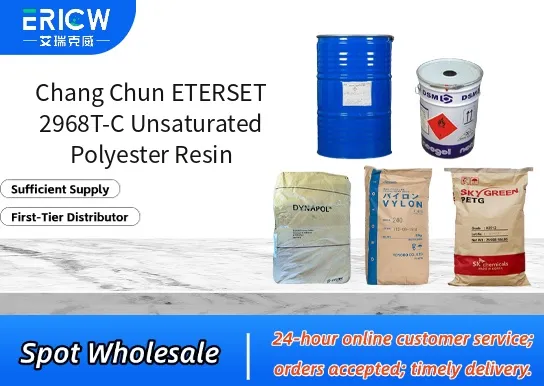
Q1: What is the primary application profile of ETERSET 2968T-C?
A: ETERSET 2968T-C is specially formulated for high-performance laminating and casting applications requiring excellent mechanical strength, dimensional stability, and good surface finish—commonly used in marine components, industrial tanks, and structural FRP parts.
Q2: How does ETERSET 2968T-C differ from standard orthophthalic resins?
A: It features a modified isophthalic/neo-pentyl glycol backbone, offering enhanced hydrolytic resistance, improved toughness, and superior compatibility with both glass fiber reinforcements and common low-profile additives compared to conventional orthophthalic systems.
Q3: What are typical curing conditions and initiator recommendations?
A: Standard room-temperature curing uses methyl ethyl ketone peroxide (MEKP) at dosages generally ranging from 0.1% to 2% by weight, depending on ambient temperature and required gel time. Post-cure at elevated temperatures may be applied to optimize final crosslink density and thermal performance.
Q4: Is ETERSET 2968T-C suitable for use with low-shrink or low-profile additives?
A: Yes—it demonstrates good compatibility with common thermoplastic low-profile additives (e.g., PVAc or PS-based systems), supporting reduced internal stress and improved surface aesthetics in thick-section castings and molded parts.
Q5: What storage considerations apply to maintain resin stability?
A: Store in tightly sealed containers at temperatures between 15°C and 25°C, away from direct sunlight and sources of heat or ignition. Prolonged exposure to temperatures above 30°C or repeated freeze-thaw cycles should be avoided to preserve reactivity and viscosity consistency.
Contact With Us:
E-mail: wangxingqiang@ericwchem.com
Have a Questions? Call Us:
Add:
Building A1, Jiete Industrial Park, Huangpu District, Guangzhou City, Guangdong Province, China