English
 Español
 tiếng việt
 русский
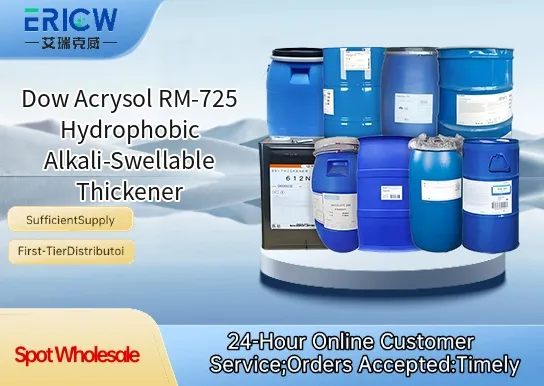
Delivers high-shear viscosity stability in waterborne formulations, minimizing sag and drip during application.
Provides excellent resistance to microbial degradation due to its hydrophobic backbone and low-water-activity structure.
Offers robust thickening performance across a broad pH range (7.5–10.5) after alkaline activation.
Enhances latex coalescence and film formation without compromising open time or leveling.
Enables efficient rheology control with low dosage requirements—typically 0.2–0.6 wt% on total formulation basis.
Interior and exterior architectural paints and coatings.
Water-based industrial maintenance coatings.
Textile printing pastes requiring high-thixotropy and shear recovery.
Adhesives and sealants where non-drip rheology and storage stability are critical.
Tile grouts and cementitious repair mortars with water-reduced formulations.
| Chemical Type | Hydrophobically modified alkali-swellable emulsion (HASE) |
| Product Form | Aqueous dispersion |
| Appearance | Opaque white liquid |
| pH (as received) | 3.0–4.5 |
| Active Content | 28–32 wt% |
| Viscosity (Brookfield RVT, Spindle #3, 20 rpm, 25°C) | 500–2,500 cP |
| Freeze-Thaw Stability | Pass (3 cycles at –15°C/24 h followed by 25°C/24 h) |
| Primary Applications | Architectural paints, industrial coatings, adhesives, grouts |
Q1: What is the primary thickening mechanism of RM-725?
A: RM-725 is an associative, hydrophobic alkali-swellable emulsion (HASE) thickener. It functions by swelling and solubilizing in alkaline conditions (typically pH ≥ 8.0), while its hydrophobic groups interact with other hydrophobic components in the formulation—such as surfactants or polymer particles—to form a transient, three-dimensional network that imparts viscosity and rheological control.
Q2: How does RM-725 differ from non-hydrophobic ASE thickeners like RM-2020 or RM-825?
A: Unlike conventional alkali-swellable emulsion (ASE) thickeners, RM-725 incorporates carefully balanced hydrophobic modifications. This enhances its associative character, delivering superior mid-shear viscosity build, improved sag resistance in architectural coatings, and better tolerance to surfactants and co-solvents—without requiring high levels of neutralization or extensive post-addition aging.
Q3: What is the recommended addition method for RM-725 in water-based formulations?
A: RM-725 should be added during the let-down stage, after pH adjustment to ≥ 8.0 using ammonia or other suitable organic bases. It is typically incorporated under moderate agitation and allowed to hydrate for 15–30 minutes before final viscosity evaluation. Pre-dilution with water or formulation water phase may aid dispersion, but direct addition at low shear is generally effective.
Q4: Is RM-725 compatible with biocides commonly used in architectural and industrial coatings?
A: Yes, RM-725 demonstrates good compatibility with standard isothiazolinone and benzisothiazolinone-based biocides when used at typical dosage levels. However, as with all polymeric additives, compatibility testing under actual formulation conditions—including challenge testing—is recommended prior to full-scale implementation.
Contact With Us:
E-mail: wangxingqiang@ericwchem.com
Have a Questions? Call Us:
Add:
Building A1, Jiete Industrial Park, Huangpu District, Guangzhou City, Guangdong Province, China