English
 Español
 tiếng việt
 русский
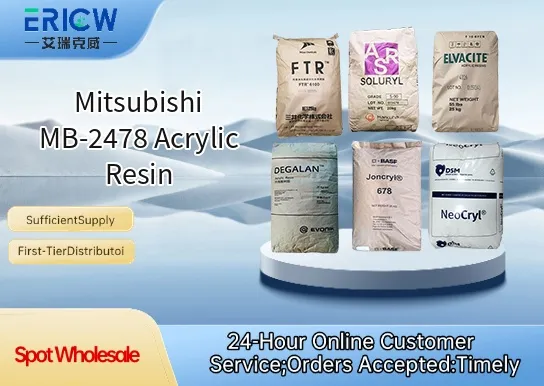
High transparency and excellent clarity for optical-grade coatings.
Outstanding UV resistance and long-term weatherability without yellowing.
Good compatibility with common solvent-based coating systems and crosslinkers.
Low viscosity in solution, enabling easy formulation and high-solids application.
Consistent batch-to-batch performance ensured by Mitsubishi’s stringent quality control.
Automotive clearcoats and OEM topcoats.
Industrial maintenance coatings for metal and plastic substrates.
Architectural exterior coatings requiring durability and gloss retention.
Plastic coatings for consumer electronics housings and automotive interior trim.
High-performance coil coatings for pre-painted metal applications.
| Chemical Type | Thermoplastic acrylic copolymer |
| Product Form | Solvent solution (typically in toluene/xylene or mixed aromatic solvents) |
| Appearance | Clear, colorless to pale yellow liquid |
| Non-Volatile Content | 45–50% w/w (as supplied) |
| Gardner Color | ≤ 2 |
| Acid Value | ≤ 5 mg KOH/g |
| Viscosity (25°C, #4 spindle, 20 rpm) | 1,200–1,800 cP |
| Primary Applications | High-gloss, weather-resistant topcoats |
Q1: What is the primary function of MB-2478 in coating formulations?
A: MB-2478 is a specialty acrylic resin designed primarily as a rheology modifier and film-forming aid in water-based industrial and architectural coatings. It helps improve viscosity stability, sag resistance, and dry-film integrity without significantly compromising gloss or clarity.
Q2: Is MB-2478 compatible with common co-binders such as styrene-acrylic or vinyl acetate copolymers?
A: Yes, MB-2478 demonstrates good compatibility with a broad range of synthetic latexes, including styrene-acrylic, vinyl acetate–ethylene, and pure acrylic dispersions. Compatibility should be verified in final formulations due to sensitivity to pH, ionic strength, and surfactant systems.
Q3: How should MB-2478 be incorporated into aqueous systems to ensure optimal performance?
A: MB-2478 is typically added during the let-down stage under moderate agitation. Pre-dilution with water or a portion of the formulation’s water phase is recommended to facilitate uniform dispersion. Avoid high-shear mixing post-addition to prevent mechanical degradation of the resin structure.
Q4: Does MB-2478 contribute to improved scrub resistance or block resistance in dried films?
A: Yes — as a crosslinkable acrylic resin, MB-2478 enhances cohesive strength in the cured film, which generally supports improved scrub resistance in interior architectural coatings and reduced blocking tendency in stacked or rolled substrates.
Contact With Us:
E-mail: wangxingqiang@ericwchem.com
Have a Questions? Call Us:
Add:
Building A1, Jiete Industrial Park, Huangpu District, Guangzhou City, Guangdong Province, China